Review by: Josh Ende
Title: Grand Theft Auto IV
System: Xbox 360, Playstation 3
Price: $59.99
ESRB Rating: M for Mature
Developer: Rockstar North
Publisher: Rockstar Games
Age Range: This is a little tricky. I definitely wouldn’t recommend that anyone under 13 play this game, but anyone under 17 should be “chaperoned” by a parent to dissuade young gamers from doing anything that might be unacceptable.
Buy?: Yes! There’s no way I can keep myself from recommending this game. It may not be suited for all ages, but GTA4 is arguably the best videogame to be released in this decade. Do not pass up on this game. Even if your gamers are a little too young, I suggest buying the game and saving it until they’re mature enough to enjoy it.
Summary: You play as Niko Bellic, an immigrant from Eastern Europe who has come to America to join his cousin, Roman, in what they consider to be the “American Dream.” The whirlwind of crime and drama that ensues is their path to their shared dream.
Difficulty: Average. This entry in the series is a little easier than the previous games, but the gameplay is still geared towards more mature audiences making it challenging, but never unbeatable.
Learning Curve: Another tricky subject! About 40% of the game’s objectives walk you through everything you’ll need to be able to do to complete the game, however nothing you’re doing feels like you need to learn it. The control scheme takes some getting-used-to, but after the 10 minutes that takes, you’ll feel like you are Niko Bellic.
Total hours of play: The main story (roughly 60% of the game) can be finished in 30 hours. Completing the full 100% will take significantly longer and the multiplayer mode will provide endless hours of fun.
Family Factor: Put the kids to bed! Grand Theft Auto IV is not for everyone. This game is full of realistic graphic violence, drug and alcohol use, and the kind of sex content that you can see on late-night pay channels.
Review:
By this point it should be easy to figure out how I feel about this game. As I mentioned above, GTA4 is arguably the best video game released so far this millennium. The opening cinematic will immediately pull you into the style and feel of the game which is darker and grittier than any Grand Theft Auto game before it. Niko Bellic, the protagonist, has come to Liberty City to join his cousin, Roman, in their endeavors for a new start. We learn that Niko has a dark past and some bad history back in his home country which is never really named. We also get the impression that Niko has come to America for more than just a new life and those intentions are what get Niko and Roman into the trouble and drama that makes up most of the game’s main story. By the end, Niko will have been involved with no less than three different facets of organized crime and even the government. This is the ultimate story of cops and robbers and no one is left out. I can’t give away much more of the story without feeling like I’m giving something away, but I can assure you that GTA4’s story stands up there with the best crime movies.
How does it play though? The control scheme won’t feel like second nature until you’re about an hour into the game, but you’ll be familiar with it long before that. It’s just not as intuitive as some other games out there. If you’ve played any of the earlier GTA games then you know what to expect, but this time around, Rockstar has made a few additions to the controls to go along with some of the new gameplay that’s been implemented. The new cover system is probably the most prominent of additions and also the most useful. The easier difficulty of GTA4 (compared to earlier games) can arguably be attributed to Niko’s ability to take cover in gunfights opposed to standing out in the open and hoping the body armor lasts. The new cover system is handled decently, but it’s not as smooth as in games like the Rainbow Six Vegas series or even in Gears of War. It’s also accented with a new aiming system that gives the players more freedom and control over where their bullets land.
Vehicles have become more difficult to control, but this is offset by the new ability to hail a cab that will drive you anywhere a car can take you in Liberty City, which is roughly based on New York City. While cabs do cost money, they save time and the frustration of trying to navigate through New York-esque traffic. It’s one of the many ways that Rockstar has added realism to the series. But it’s this realism that also makes the game so much more mature than its earlier iterations.
I can go on and on about why this game should be played, but I’m going to focus now on why this shouldn’t be played. As mentioned above, and along with a new gorgeous graphics engine, GTA4 is full of gritty realism. The violence is always harder to swallow when the victims look more realistic. Rockstar has tried to water this down by letting some victims crawl away after defeat, but most gamers will respond to this by shooting retreating victims in the head since most games have conditioned gamers to shoot any bad guys that move. The language is also very strong. It’s done in a way so that it never sounds or feels out of place, but the vulgarity is definitely something you won’t want younger gamers repeating. In the last Grand Theft Auto game there was a huge controversy over simulated sex scenes. In GTA4 there is still simulated sex, though it’s nowhere near as graphic as what stirred watchdog groups four years ago. Throughout the story, Niko will meet a variety of different girls that he can take out on some interactive and fun dates such as bowling, billiards, or darts. Niko can also try his luck at the end of each date by trying to invite himself in. If he does get lucky then the furthest the game goes is some suggestive sounds and an exterior view of the girl’s home. However, Niko also has the choice to indulge in the occasional prostitute. Once parked in a secluded area the player can choose how much to spend (the higher the price, the more involved the service). The service is then acted out in a very detailed manner yet no clothes are ever removed. It’s not exactly the worst it could be, but it might not be something a child should be exposed to.
I mentioned up above that this game should be played under parental supervision for anyone under 17. Grand Theft Auto IV is a very mature game, but most of the worst aspects of it are purely player controlled and aren’t as likely to be attempted in front of parents. Otherwise the game has a lot of genuine value to it. The story and characters are accessible and interesting enough to captivate anyone even if they aren’t playing the game. And the mature themes and adult situations of the game are likely to put-off any gamers too young to really understand it.
Related games: Previous Grand Theft Auto games (Multiple platforms), Saints Row (Xbox 360), The Godfather (Multiple platforms)
Showing posts with label Reviews. Show all posts
Showing posts with label Reviews. Show all posts
Saturday, May 31, 2008


Tuesday, April 29, 2008
No More Heroes review (Wii)
Review by: Josh Ende
Title: No More Heroes
System: Nintendo Wii
Price: $49.99
ESRB Rating: M for Mature
Developer: Grasshopper Manufacture
Publisher: Ubisoft / Marvelous Interactive
Age Range: 17+
Buy?: YES! Regardless of the mature and violent tones of this game, its style and artistic value should be experienced by everyone who appreciates the creativity of video games. Perhaps it’s not a safe purchase for younger audiences, but think of it as one of those R-rated movies that you want your child to watch when they’re older.
Summary: You play as Travis Touchdown, a young guy obsessed with Japanese pop culture, and you’ve just been ranked the 11th best assassin in the world. Your goal now is to compete against, and defeat, the remaining top 10 to become #1.
Difficulty: Medium/Hard
This game is made for mature gamers and it shows in the difficulty as well. While it’s not exactly on par with the latest Ninja Gaiden games, NMH will ask you to bring nothing less than your A-game to some of the higher ranked assassins. Luckily, the style and gameplay itself will keep you from getting too frustrated and turning the system off.
Learning Curve: The learning curve is only as long as the brief training/tutorial at the beginning of the game. The button actions are far from complicated and the motion controls are too intuitive to ever forget.
Total hours of play: 10-12 hours
The linear design of NMH will keep the pace of the game fairly consistent. The only section where completion time will really vary is in between the actual missions when players have to round-up the money to pay the “set-up fee.”
Family Factor:
Although the somewhat cartoony style of No More Heroes is very appealing to audiences of all ages, No More Heroes is not a game for the entire family to gather around and enjoy. The violence and gore is on the same level as Quentin Tarantino’s Kill Bill movies and the crass humor generally revolves around sexual themes. The game also does all of this in a very non-realistic world which may confuse younger gamers.
Review:
Anyone familiar with game creator Suda 51, or Killer 7 (his last game), knows exactly what to expect out of No More Heroes: over-the-top violence carried out with a trademarked style that doesn’t compare to any other game out there (except maybe Killer 7). You play as Travis Touchdown, the 11th best assassin in the world, who wields a beam katana (lightsaber) that he won in an internet auction (eBay). There’s very little else that we know about Travis before we begin his journey to the top so he has much more of an every-man feel, but the quest he embarks on is far from an every-day affair.
No More Heroes is actually the name of a motel that Travis is living at within the city of Santa Destroy: a fictional locale with a southern-California feel to it. We never quite know the meaning of the motel’s name, nor why Santa Destroy is called as such, but we can assume that they’re just cool monikers that Suda 51 and company came up with to set-up the style of the game: very cool with little justification, and even a little satirical. The style is going to standout over the gameplay in almost every aspect of the game, and that’s not a bad thing because there’s still plenty of gameplay, but No More Heroes is a title that should forefront the argument for videogames as a form of art. By style I’m referring to the game’s visual aesthetics as well as its attitude. The graphics have a very modern, comic book-esque appearance that uses a lot of basic colors giving it an almost impressionistic look. The attitude of the game, however, is what really compliments the look. Travis could be thought of as a modern-day Japanese Fonzy with an affinity for pro wrestling and his pet cat Jeane. His style is kind of like a hipster rock star and new clothes can be bought for him to change his color-scheme, but buy too many new clothes and you’ll have to work more to pay the fee for the next battle.
After the initial, tutorial battle and introductory level, which bumps Travis up to 10th best assassin in the world, players are dropped into the body of the game. The core gameplay pattern goes as so: drive around Santa Destroy on an over-sized motorcycle doing odd jobs to raise money for the next ranking battle, pay said fee, then compete against the next ranking opponent, rinse, lather, repeat. Following the same pattern over and over again may sound like it gets boring, and it might for a few gamers, but each win as Travis climbs the top ten list will unlock new odd jobs (such as coconut collecting and lawn mowing) and new assassination missions that require players to meet objectives such as only using wrestling moves to defeat the bad guys or defeating all enemies without getting hit. The variety of these missions and odd jobs isn’t too broad so players will be repeating missions and jobs they’ve already done to earn enough money for the next battle, but the satisfying combat and controls keep these smaller missions from getting too stale.
The combat itself is very intuitive and easy to learn even if you skipped-out on the tutorial at the beginning of the game (which is an option). It won’t require players to stand up nor constantly aim the Wii remote at the screen, but it does use the Wii’s motion-sensing capabilities to finish off enemies with a swipe of the controller as well as other contextual controls that are prompted during the game. The violence is very over-the-top and very bloody, but it’s not necessarily as graphic as you might expect. Because of the art style, the gruesome deaths in NMH feel fairly watered-down. Bad guys will get limbs chopped off, get decapitated, and even get sliced in half by Travis’ beam katana, but the impressionistic style of the characters make them look a little more like paper dolls than like real people; and the blood that sprays from these fatal wounds seems more like fruit punch than human blood.
The dialogue is going to throw up another red flag. No More Heroes has more than its share of f-bombs and other seemingly inappropriate language which is used rather liberally. It’s obvious from the beginning that NMH is a product of Japan because the English translations and voice-acting will make you cringe and laugh, both in ridicule and from humor. The humor though is an interesting aspect in itself. You’ll often roll your eyes at Travis’ sexual desperation and at his corny one-liners, but that also makes it easier to see NMH as satirical.
Going along with the idea of NMH as a satire it’ll be easier to accept the over-the-topness, exaggerated action, and ridiculous dialog, but satire or not, No More Heroes is a great game. The violence, language, and some adult themes keep me from recommending it for everyone, but if movies like Kill Bill, or even the Blade series, are acceptable then Suda 51’s No More Heroes is a must-have title.
Related games: Killer 7 (GameCube, PS2), Grand Theft Auto series (multiple platforms)
Title: No More Heroes
System: Nintendo Wii
Price: $49.99
ESRB Rating: M for Mature
Developer: Grasshopper Manufacture
Publisher: Ubisoft / Marvelous Interactive
Age Range: 17+
Buy?: YES! Regardless of the mature and violent tones of this game, its style and artistic value should be experienced by everyone who appreciates the creativity of video games. Perhaps it’s not a safe purchase for younger audiences, but think of it as one of those R-rated movies that you want your child to watch when they’re older.
Summary: You play as Travis Touchdown, a young guy obsessed with Japanese pop culture, and you’ve just been ranked the 11th best assassin in the world. Your goal now is to compete against, and defeat, the remaining top 10 to become #1.
Difficulty: Medium/Hard
This game is made for mature gamers and it shows in the difficulty as well. While it’s not exactly on par with the latest Ninja Gaiden games, NMH will ask you to bring nothing less than your A-game to some of the higher ranked assassins. Luckily, the style and gameplay itself will keep you from getting too frustrated and turning the system off.
Learning Curve: The learning curve is only as long as the brief training/tutorial at the beginning of the game. The button actions are far from complicated and the motion controls are too intuitive to ever forget.
Total hours of play: 10-12 hours
The linear design of NMH will keep the pace of the game fairly consistent. The only section where completion time will really vary is in between the actual missions when players have to round-up the money to pay the “set-up fee.”
Family Factor:
Although the somewhat cartoony style of No More Heroes is very appealing to audiences of all ages, No More Heroes is not a game for the entire family to gather around and enjoy. The violence and gore is on the same level as Quentin Tarantino’s Kill Bill movies and the crass humor generally revolves around sexual themes. The game also does all of this in a very non-realistic world which may confuse younger gamers.
Review:
Anyone familiar with game creator Suda 51, or Killer 7 (his last game), knows exactly what to expect out of No More Heroes: over-the-top violence carried out with a trademarked style that doesn’t compare to any other game out there (except maybe Killer 7). You play as Travis Touchdown, the 11th best assassin in the world, who wields a beam katana (lightsaber) that he won in an internet auction (eBay). There’s very little else that we know about Travis before we begin his journey to the top so he has much more of an every-man feel, but the quest he embarks on is far from an every-day affair.
No More Heroes is actually the name of a motel that Travis is living at within the city of Santa Destroy: a fictional locale with a southern-California feel to it. We never quite know the meaning of the motel’s name, nor why Santa Destroy is called as such, but we can assume that they’re just cool monikers that Suda 51 and company came up with to set-up the style of the game: very cool with little justification, and even a little satirical. The style is going to standout over the gameplay in almost every aspect of the game, and that’s not a bad thing because there’s still plenty of gameplay, but No More Heroes is a title that should forefront the argument for videogames as a form of art. By style I’m referring to the game’s visual aesthetics as well as its attitude. The graphics have a very modern, comic book-esque appearance that uses a lot of basic colors giving it an almost impressionistic look. The attitude of the game, however, is what really compliments the look. Travis could be thought of as a modern-day Japanese Fonzy with an affinity for pro wrestling and his pet cat Jeane. His style is kind of like a hipster rock star and new clothes can be bought for him to change his color-scheme, but buy too many new clothes and you’ll have to work more to pay the fee for the next battle.
After the initial, tutorial battle and introductory level, which bumps Travis up to 10th best assassin in the world, players are dropped into the body of the game. The core gameplay pattern goes as so: drive around Santa Destroy on an over-sized motorcycle doing odd jobs to raise money for the next ranking battle, pay said fee, then compete against the next ranking opponent, rinse, lather, repeat. Following the same pattern over and over again may sound like it gets boring, and it might for a few gamers, but each win as Travis climbs the top ten list will unlock new odd jobs (such as coconut collecting and lawn mowing) and new assassination missions that require players to meet objectives such as only using wrestling moves to defeat the bad guys or defeating all enemies without getting hit. The variety of these missions and odd jobs isn’t too broad so players will be repeating missions and jobs they’ve already done to earn enough money for the next battle, but the satisfying combat and controls keep these smaller missions from getting too stale.
The combat itself is very intuitive and easy to learn even if you skipped-out on the tutorial at the beginning of the game (which is an option). It won’t require players to stand up nor constantly aim the Wii remote at the screen, but it does use the Wii’s motion-sensing capabilities to finish off enemies with a swipe of the controller as well as other contextual controls that are prompted during the game. The violence is very over-the-top and very bloody, but it’s not necessarily as graphic as you might expect. Because of the art style, the gruesome deaths in NMH feel fairly watered-down. Bad guys will get limbs chopped off, get decapitated, and even get sliced in half by Travis’ beam katana, but the impressionistic style of the characters make them look a little more like paper dolls than like real people; and the blood that sprays from these fatal wounds seems more like fruit punch than human blood.
The dialogue is going to throw up another red flag. No More Heroes has more than its share of f-bombs and other seemingly inappropriate language which is used rather liberally. It’s obvious from the beginning that NMH is a product of Japan because the English translations and voice-acting will make you cringe and laugh, both in ridicule and from humor. The humor though is an interesting aspect in itself. You’ll often roll your eyes at Travis’ sexual desperation and at his corny one-liners, but that also makes it easier to see NMH as satirical.
Going along with the idea of NMH as a satire it’ll be easier to accept the over-the-topness, exaggerated action, and ridiculous dialog, but satire or not, No More Heroes is a great game. The violence, language, and some adult themes keep me from recommending it for everyone, but if movies like Kill Bill, or even the Blade series, are acceptable then Suda 51’s No More Heroes is a must-have title.
Related games: Killer 7 (GameCube, PS2), Grand Theft Auto series (multiple platforms)
Rayman: Raving Rabbids review (Wii)
Reviewer: Carrie Scherach
Title: Rayman: Raving Rabbids
Platform: Nintendo Wii
Price: $29.99
Rating: E for Everyone
Developer: Ubisoft
Publisher: Ubisoft
Age Range: 7 and up. Raving Rabbids has no violence and gives a humorous story line to follow. Upbeat music, energetic mini-games, and adorably odd rabbits make this game fun for all ages.
Buy It?: Yes. This is a definite buy that is great for family and friends. With up to 4 players, this a great game to get everyone involved. It takes great advantage of the motion and activity sensors incorporated in the Wii remote, for the best Rayman gaming experience yet.
Difficulty: Medium difficulty level. The mini games get harder as you progress through the game, but not impossible.
Learning Curve: Easy to pick up after a few mini games.
Total Hours of Play: About 9 hours
Family Factor:
Rayman fights the enemy rabbids in uncanny, but humorous mini games using bizarre objects, such as plunger guns and space ships. The game consists of races, shooting rabbids, dancing bunnies, and skill games. With no violence and silly antics, this is a definite must for almost any age.
Review:
Rayman begins the game picnicking, when he is approached by a swarm of raving rabbids, and ultimately thrust into an olympic arena with 4 challenges and a first person shooter board per level. After going through various levels, Rayman collects new items and outfits to adorn the cell that he has been imprisoned in if you complete every challenge. Don’t worry—if you can’t finish one of the challenges you can come back at a later time to finish the challenge. After each level he is awarded a plunger, which builds a ladder to his freedom.
The rabbids will win your heart with their hysterical gibberish screams and humorous attacks on Rayman. They blend to scenery with costumes and props as the setting changes with each level, from the wild west to a scary graveyard, and much more.
Raving Rabbids has been designed specifically for the Wii’s hands-on, action capabilities. The game design takes advantage of the Wii controls, with fun games, that get you moving and using the remote and your body to the full extent. A fun game to play with friends and family, Raving Rabbids features various mini-games. The games can be played through to challenge one player in story mode or up to four plays can duel it out as a party game. The games are amusing, and the ongoing humor pulls you into the story. You’ll find yourself and friends laughing as you swing your Wiimote around in circles over your head to see who can toss a cow further, or using the Wiimote and nunchuck as drum sticks while you collect dancing rabbids in a ‘Rock Band’ style challenge to name a few.
Some pitfalls like most games in this genre is the repeatitive music. The developer has spiced things up with offering some classic songs like ‘Girls Just Wanna Have Fun’ by having it sung by the Rabbids themselves which is cute for only so long. The up side is that you’ll find yourself singing along. Another negative which may discourage some players is the similarity of the mini-games. It can feel that once you’re half way through the game, you’re just playing the same mini-games over again.
Overall, the game combines the motion-sensor advantage of the Wii remote, with off the wall fun in the mini-games. The games vary from sports and races to shooting and dancing games. With over 70 eccentric games to play, Rayman Raving Rabbids is a definite buy.
Related Games: Mario Party 8, Wario Smooth Moves
Title: Rayman: Raving Rabbids
Platform: Nintendo Wii
Price: $29.99
Rating: E for Everyone
Developer: Ubisoft
Publisher: Ubisoft
Age Range: 7 and up. Raving Rabbids has no violence and gives a humorous story line to follow. Upbeat music, energetic mini-games, and adorably odd rabbits make this game fun for all ages.
Buy It?: Yes. This is a definite buy that is great for family and friends. With up to 4 players, this a great game to get everyone involved. It takes great advantage of the motion and activity sensors incorporated in the Wii remote, for the best Rayman gaming experience yet.
Difficulty: Medium difficulty level. The mini games get harder as you progress through the game, but not impossible.
Learning Curve: Easy to pick up after a few mini games.
Total Hours of Play: About 9 hours
Family Factor:
Rayman fights the enemy rabbids in uncanny, but humorous mini games using bizarre objects, such as plunger guns and space ships. The game consists of races, shooting rabbids, dancing bunnies, and skill games. With no violence and silly antics, this is a definite must for almost any age.
Review:
Rayman begins the game picnicking, when he is approached by a swarm of raving rabbids, and ultimately thrust into an olympic arena with 4 challenges and a first person shooter board per level. After going through various levels, Rayman collects new items and outfits to adorn the cell that he has been imprisoned in if you complete every challenge. Don’t worry—if you can’t finish one of the challenges you can come back at a later time to finish the challenge. After each level he is awarded a plunger, which builds a ladder to his freedom.
The rabbids will win your heart with their hysterical gibberish screams and humorous attacks on Rayman. They blend to scenery with costumes and props as the setting changes with each level, from the wild west to a scary graveyard, and much more.
Raving Rabbids has been designed specifically for the Wii’s hands-on, action capabilities. The game design takes advantage of the Wii controls, with fun games, that get you moving and using the remote and your body to the full extent. A fun game to play with friends and family, Raving Rabbids features various mini-games. The games can be played through to challenge one player in story mode or up to four plays can duel it out as a party game. The games are amusing, and the ongoing humor pulls you into the story. You’ll find yourself and friends laughing as you swing your Wiimote around in circles over your head to see who can toss a cow further, or using the Wiimote and nunchuck as drum sticks while you collect dancing rabbids in a ‘Rock Band’ style challenge to name a few.
Some pitfalls like most games in this genre is the repeatitive music. The developer has spiced things up with offering some classic songs like ‘Girls Just Wanna Have Fun’ by having it sung by the Rabbids themselves which is cute for only so long. The up side is that you’ll find yourself singing along. Another negative which may discourage some players is the similarity of the mini-games. It can feel that once you’re half way through the game, you’re just playing the same mini-games over again.
Overall, the game combines the motion-sensor advantage of the Wii remote, with off the wall fun in the mini-games. The games vary from sports and races to shooting and dancing games. With over 70 eccentric games to play, Rayman Raving Rabbids is a definite buy.
Related Games: Mario Party 8, Wario Smooth Moves
Super Smash Bros. Brawl review (Wii)
Review by: Craig Reck
Title: Super Smash Bros. Brawl
System: Nintendo Wii
Price: $49.99
ESRB Rating: T for Teen (13+)
Developer: Sora
Publisher: Nintendo
Age Range: 9+. A teen rating is too strict. Children who watch cartoons will see the same types of “crude humor” and “cartoon violence” in a typical cartoon show that they will in this game.
Buy?: Of course! As a corner stone of the Wii, this game has something for everyone. Young children will enjoy the enticing visuals, scene-setting music and easily-learned controls, while anyone (including parents) can become lost in the fierce competition.
Summary: Brawl picks up where its predecessor, Super Smash Bros. Melee, left off. The concept has remained the same, but the characters, levels, add-ons and excitement have all increased. Plus, a “level-creator” feature allows players to use their creativity to build their own level.
Difficulty: This game is as difficult as you want to make it. Choose from the five difficulties ranging from “very easy” to “intense.” Up the difficulty setting as your confidence grows in your “smashing” ability.
Learning Curve: Although it only takes an hour to learn the controls and how the game is played, mastering your skills will take much longer.
Total hours of play: Brawl is so full of trophies, stickers and other extra collectibles that you will be playing this game for quite a while until you completely beat it.
Family Factor: The biggest problem that you might have with Brawl is the fact that it is a fighting game. Far from the likes of typical fighting games that are branded violent and graphic, Brawl is tame and within reason. It reinvents the idea of a fighting game because there is no blood, bruises or name-calling. However, if you are offended with a character breaking wind in order to cause damage to his opponents, you might want to try another title.
Review:
Super Smash Bros. Brawl picks up where its predecessor, Super Smash Bros. Melee, left off. The concept of a 4-player battle royale has remained the same, but the characters, levels, add-ons and excitement have all increased. Plus, a “level-creator” feature allows players’ creativity to flourish and design their own battlegrounds.
Learning the basic controls for Brawl is easy. Press the “A” button for a standard attack and the “B” button for a special attack. Add some movement of the joystick while pressing an attack button and an entirely different, and usually more powerful, attack is performed.
There is much debate over which controller is most conducive for gameplay, as the GameCube controller and the Wii Remote are both compatible with Brawl. Super Smash Bros connoisseurs who have followed the series since its Nintendo 64 days will argue that using the Gambecube controller is the only way to play. However, using the Wiimote and Nunchuk give the player freedom to move his/her hands freely while being caught up in fierce battles. As a past supporter of the Gamecube controller, I must admit that I have been converted into a Wiimote user. Gamecube is in the past, so it’s time to give up the system and its controllers. Use a Wiimote and play Brawl the way it was meant to be.
Aside from the mountain of extra unlockable goodies, Brawl has two new features that prove it’s worth one of the top spots in your video game library. The Subspace Emissary, a new story mode for the Brawl competitors, allows a single player to fully enjoy a game that is known its multi-player matches. The second feature comes from the field of new items that can be used on al Brawl terrain. The Final Smash Ball is the ultimate item. All Brawling ceases when this item appears and competitors begin to battle for it instead. Every character has Final Smash unique to their personality and style. If you are unlucky enough to miss the chance to obtain the Ball, be sure to run and hide immediately.
Super Smash Bros. continues to improve graphically and aurally with Brawl. The levels are full of depth and the characters are more detailed than ever. If you need music to put you in the Brawling mood, there is no need to worry. There is more music, most of it unlockable as you progress through the game, than you have time to actually listen to it.
The biggest problem with this installment of the Super Smash Bros. series is the longevity of a brawl. All competitors have better recovery skills and can return to the board much easier. This leads to longer matches and frustration if there are not enough controllers for everyone in the room.
Related games: Soul Calibur IV (PS3, Xbox 360), Mario Party 8 (Wii), Super Mario Galaxy (Wii)
Title: Super Smash Bros. Brawl
System: Nintendo Wii
Price: $49.99
ESRB Rating: T for Teen (13+)
Developer: Sora
Publisher: Nintendo
Age Range: 9+. A teen rating is too strict. Children who watch cartoons will see the same types of “crude humor” and “cartoon violence” in a typical cartoon show that they will in this game.
Buy?: Of course! As a corner stone of the Wii, this game has something for everyone. Young children will enjoy the enticing visuals, scene-setting music and easily-learned controls, while anyone (including parents) can become lost in the fierce competition.
Summary: Brawl picks up where its predecessor, Super Smash Bros. Melee, left off. The concept has remained the same, but the characters, levels, add-ons and excitement have all increased. Plus, a “level-creator” feature allows players to use their creativity to build their own level.
Difficulty: This game is as difficult as you want to make it. Choose from the five difficulties ranging from “very easy” to “intense.” Up the difficulty setting as your confidence grows in your “smashing” ability.
Learning Curve: Although it only takes an hour to learn the controls and how the game is played, mastering your skills will take much longer.
Total hours of play: Brawl is so full of trophies, stickers and other extra collectibles that you will be playing this game for quite a while until you completely beat it.
Family Factor: The biggest problem that you might have with Brawl is the fact that it is a fighting game. Far from the likes of typical fighting games that are branded violent and graphic, Brawl is tame and within reason. It reinvents the idea of a fighting game because there is no blood, bruises or name-calling. However, if you are offended with a character breaking wind in order to cause damage to his opponents, you might want to try another title.
Review:
Super Smash Bros. Brawl picks up where its predecessor, Super Smash Bros. Melee, left off. The concept of a 4-player battle royale has remained the same, but the characters, levels, add-ons and excitement have all increased. Plus, a “level-creator” feature allows players’ creativity to flourish and design their own battlegrounds.
Learning the basic controls for Brawl is easy. Press the “A” button for a standard attack and the “B” button for a special attack. Add some movement of the joystick while pressing an attack button and an entirely different, and usually more powerful, attack is performed.
There is much debate over which controller is most conducive for gameplay, as the GameCube controller and the Wii Remote are both compatible with Brawl. Super Smash Bros connoisseurs who have followed the series since its Nintendo 64 days will argue that using the Gambecube controller is the only way to play. However, using the Wiimote and Nunchuk give the player freedom to move his/her hands freely while being caught up in fierce battles. As a past supporter of the Gamecube controller, I must admit that I have been converted into a Wiimote user. Gamecube is in the past, so it’s time to give up the system and its controllers. Use a Wiimote and play Brawl the way it was meant to be.
Aside from the mountain of extra unlockable goodies, Brawl has two new features that prove it’s worth one of the top spots in your video game library. The Subspace Emissary, a new story mode for the Brawl competitors, allows a single player to fully enjoy a game that is known its multi-player matches. The second feature comes from the field of new items that can be used on al Brawl terrain. The Final Smash Ball is the ultimate item. All Brawling ceases when this item appears and competitors begin to battle for it instead. Every character has Final Smash unique to their personality and style. If you are unlucky enough to miss the chance to obtain the Ball, be sure to run and hide immediately.
Super Smash Bros. continues to improve graphically and aurally with Brawl. The levels are full of depth and the characters are more detailed than ever. If you need music to put you in the Brawling mood, there is no need to worry. There is more music, most of it unlockable as you progress through the game, than you have time to actually listen to it.
The biggest problem with this installment of the Super Smash Bros. series is the longevity of a brawl. All competitors have better recovery skills and can return to the board much easier. This leads to longer matches and frustration if there are not enough controllers for everyone in the room.
Related games: Soul Calibur IV (PS3, Xbox 360), Mario Party 8 (Wii), Super Mario Galaxy (Wii)
Monday, April 28, 2008
NHL 2008 review (Xbox 360)
Review by: Will Kirschner
Title: NHL 2008
Platform: Playstation 3, Xbox 360, Playstation 2, PC
Price: $59.99 (Xbox 360 and Playstation 3) $29.99 (Playstation 2) $19.99 (PC)
ESRB Rating: E for Everyone
Developer: EA Canada
Publisher: Electronic Arts
Age Range: This game is appropriate for any age and can be played by anyone.
Buy?: I love everything hockey so it pains me to say this but it is definitely not worth the better part of a hundred bucks to get this on a next generation console. Your much better off getting the cheaper NHL 2K8 to fulfill your hockey hearts desire.
Summary: Lead your team to hoisting the Stanley Cup and complete victory. You take control of all aspects of a franchise and try and make your team the next great hockey dynasty.
Difficulty: Way too easy, way too lame. The shooting system, though much more realistic, is overly difficult for a simulation hockey game. There shouldn't be a way for me too drop six goals on one of the best goalies in the game as soon as I pick up my controller. I ended up simulating a good deal of the season and skipping over many games due to the boredom the game caused me.
Learning Curve: However long it takes you to learn the buttons of the game is how long it will take to master it.
Total Hours of Play: To beat a franchise it will take you 30+ plus hours of your life. To play a singular game it takes 30 minutes.
Family Factor: This game is hockey dumbed down for the kids. Checking systems is flawed because landing a good check is pretty much impossible. Fights happen, but they happen so rarely it isn't even worth learning the buttons.
Review:
I enjoyed this game at the beginning for all the wrong reasons: it let me beat the Devils up and down the rink. Otherwise, this isn't worth the disks it was written on.
Let me start with the passing system. The puck moves slowly, so strong fluid passes don't exist, leading to tons of interceptions. This can make a team attempt on goal nearly impossible. Luckily, skating is a breeze. Any average Joe could skate past the leagues best defenders and drop one in on the goalie. The new skating system is pretty, but skating for skating's sake would make this a figure skating game.
And, they ruined checking... they ruined checking! One of the most sacred tenants of hockey, defense at any cost, has been wrecked by this game. All too often I just glided in front of the net and dropped the puck in without any succesful checks from the computer’s team. This happened to me too, where I would just slide past an opponent, or even into him, and he wouldn't fall. There is nothing more annoying then being scored on because your check fails.
This brings me to the final point. Don’t buy this game! Fortunately for me this was my brother's purchase, and I played a whole season, simulating most of it to skip games and save my sanity. Online is barely redeemable because very few people play on it. The Owner’s Mode is the only redeeming point because there are a surprising number of things you can do with your players, like train them and build up your minor leaguers to superstar status.
This isn't a good reason to buy it though. Learn from my mistake and save your sixty bucks for something more worthwhile.
Related Games: NHL 2K7
Title: NHL 2008
Platform: Playstation 3, Xbox 360, Playstation 2, PC
Price: $59.99 (Xbox 360 and Playstation 3) $29.99 (Playstation 2) $19.99 (PC)
ESRB Rating: E for Everyone
Developer: EA Canada
Publisher: Electronic Arts
Age Range: This game is appropriate for any age and can be played by anyone.
Buy?: I love everything hockey so it pains me to say this but it is definitely not worth the better part of a hundred bucks to get this on a next generation console. Your much better off getting the cheaper NHL 2K8 to fulfill your hockey hearts desire.
Summary: Lead your team to hoisting the Stanley Cup and complete victory. You take control of all aspects of a franchise and try and make your team the next great hockey dynasty.
Difficulty: Way too easy, way too lame. The shooting system, though much more realistic, is overly difficult for a simulation hockey game. There shouldn't be a way for me too drop six goals on one of the best goalies in the game as soon as I pick up my controller. I ended up simulating a good deal of the season and skipping over many games due to the boredom the game caused me.
Learning Curve: However long it takes you to learn the buttons of the game is how long it will take to master it.
Total Hours of Play: To beat a franchise it will take you 30+ plus hours of your life. To play a singular game it takes 30 minutes.
Family Factor: This game is hockey dumbed down for the kids. Checking systems is flawed because landing a good check is pretty much impossible. Fights happen, but they happen so rarely it isn't even worth learning the buttons.
Review:
I enjoyed this game at the beginning for all the wrong reasons: it let me beat the Devils up and down the rink. Otherwise, this isn't worth the disks it was written on.
Let me start with the passing system. The puck moves slowly, so strong fluid passes don't exist, leading to tons of interceptions. This can make a team attempt on goal nearly impossible. Luckily, skating is a breeze. Any average Joe could skate past the leagues best defenders and drop one in on the goalie. The new skating system is pretty, but skating for skating's sake would make this a figure skating game.
And, they ruined checking... they ruined checking! One of the most sacred tenants of hockey, defense at any cost, has been wrecked by this game. All too often I just glided in front of the net and dropped the puck in without any succesful checks from the computer’s team. This happened to me too, where I would just slide past an opponent, or even into him, and he wouldn't fall. There is nothing more annoying then being scored on because your check fails.
This brings me to the final point. Don’t buy this game! Fortunately for me this was my brother's purchase, and I played a whole season, simulating most of it to skip games and save my sanity. Online is barely redeemable because very few people play on it. The Owner’s Mode is the only redeeming point because there are a surprising number of things you can do with your players, like train them and build up your minor leaguers to superstar status.
This isn't a good reason to buy it though. Learn from my mistake and save your sixty bucks for something more worthwhile.
Related Games: NHL 2K7
Monday, April 21, 2008
Crackdown (Xbox 360)
Reviewer: Erich Hiner

Title: Crackdown
Platform: Xbox 360
Price: $29.99 and up
ESRB Rating: M for Mature
Developer: Realtime Worlds
Publisher: Microsoft Game Studios
Age Range: 17+
BUY?: NO
While Crackdown includes exciting abilities and enjoyable gameplay, the shallowness of the game’s design keeps it from being a must-buy title. The over-the-top jumping and gunplay are thrilling at first but lose their luster after several hours. Driving is a chore with vehicles only becoming of interest towards the end of the game. Because the player’s superhuman abilities peak very early, there is nothing more to work towards after the player has maximized his or her skill set. Crackdown is decent but fails to use its unique game mechanics to their full extent. Curious gamers should check it out with a rental.
Summary:
Street gangs have run amok in Pacific City. With law enforcement hopelessly overextended, the newly formed Agency turns to its genetically enhanced super soldiers to turn the tide in the war on crime. The player will develop their skills as they chip away at the gangs’ infrastructures. By taking down gang bosses, the player will weaken the defenses of the each gang’s kingpin in order to release Pacific City from the grip of organized crime once and for all.
Total Hours of Play:
Most players will finish Crackdown in less than 15 hours. This may vary depending on how much time one spends upgrading skills that are not entirely necessary to winning the game. By focusing entirely on improving their strength and firearms capabilities, a player may defeat the final boss in less than 12.
Difficulty: EASY- MEDIUM
Crackdown is made easy by the pitiful enemy intelligence programming and the ability of the player to simply run past most of the enemies. Early bosses will be problematic due to the fact the player will not have a well-developed skill set when taking them on. When the player maximizes his or her skills, even the most menacing gang stronghold can be dealt with in a matter of minutes. Some later bosses prove difficult because of their inexhaustible armies of overpowered henchmen.
Family Factor:
Crackdown is cartoony in appearance but contains a great deal of adult content. Criminals can be dealt with in a number of brutal ways. While there is very little blood and no gore to speak of, bodies of fallen criminals plummet from buildings like limp dolls and are thrown violently by nearby explosions. The characters in the game also shout obscenities when combat ensues. Crackdown looks and plays like an interactive, adult-themed comic book. It should only be purchased for adults and older teens.
Review:
Crackdown has succeeded in taking the popular open-world formula of the Grand Theft Auto series and has successfully added several larger-than-life character abilities to create what is perhaps one of the best superhero games to date. The entirety of Pacific City is open for exploration from the beginning of the game. Only the player’s skills and ingenuity stand between the player and bringing order to the streets. However, the core gameplay is riddled with unforgivable flaws. Crackdown’s brevity, sloppiness and lack of content will turn off many prospective players.
 Crackdown’s stylized graphics is one of its most unique features. The art style appears at first to be hand-drawn. Every character and object is bordered by a heavy black line, which adds an interesting comic-like feel to the game. Pacific City is beautifully rendered and surprisingly intricate. In addition, the draw distance (the distance the player can see from a high vantage point without the landscape becoming blurry) is quite impressive. It should also be mentioned that the game never has to pause to load sections of the landscape as the player travels. Considering the size of the environment, this is an admirable feat.
Crackdown’s sound is nothing out of the ordinary. The weapons and explosions all sound alike. The greatest disappointment here is the sheer lack of music. Music only plays when the player enters a vehicle, an act which will be rare for most players. Even when driving, the musical selections all share a droning, falsified techno feel. To make matters worse, every musical track is accompanied by an irritating on-screen popup that displays the artist, album, and record label of the song being played. This annoyance cannot be turned off and takes away from the already below-average musical selections.
Fortunately, Crackdown’s gameplay is mostly fun and interesting. The abilities are excellently rendered and are a blast to use. Throwing buses at bad guys never really gets old and jumping from rooftop to rooftop is one of the most amusing and efficient ways to traverse the cityscape. Explosions are exhilarating and absurdly powerful. Everything facet of the game is ridiculously over-done, lending the game a welcome action-movie flavor. Sadly, even the best concepts in Crackdown are needlessly hampered by the sloppy design.
While firearms function reasonably well, the targeting system that Crackdown uses is eerily reminiscent of the troubled control scheme used by Grand Theft Auto III. Targeting enemies is frustrating and difficult. During firefights, my character would seldom zoom in on the target I wanted. I often found myself firing on fellow police officers, civilians, or dead criminals because the targeting system chose to lock onto a friendly (or deceased) character as opposed to a hostile. I also found that the superhuman abilities, while thrilling at first, reached their full potential in just a few short hours. With my character at full strength, it made more sense to avoid enemies than to engage them. The skills are too easy to upgrade and peak too quickly. I felt no incentive to approach tasks in ways that would improve my skill set because my character was already at his best. Crackdown fails to reward players beyond the first few hours of play.
Crackdown’s greatest flaw is in its emptiness. Pacific City is sprawling and remarkably accessible but lacks variety. Outside taking down gang bosses there is little else to do. The city contains multiple races that help the player to boost their skills. However, these brief time trials are pointless once the player has reached their height. Another of Crackdown’s greatest pitfalls is its lack of core gameplay. The game itself maxes out at a scant 15 hours. When the player takes down a gang’s kingpin, the entire gang permanently disappears from the streets. Once gangs disappear, there is no longer anything to do in entire segments of the city. Once the last kingpin is taken care of, there is nothing left to do in the game aside from a few mediocre time trials and an abysmal cooperative mode that is only available via Xbox LIVE.
Overall, Crackdown is a game that delivers exactly what it promises. Explosions are plentiful, enemies are abundant, and the mutant-like skills of the game’s protagonists are beyond comparison. Crackdown does well in developing its unique superhero abilities but fails to round out the rest of its gameplay.
Related Games:
The Grand Theft Auto series (multiple platforms), Mercenaries (Xbox, PS2), Lost Planet: Extreme Condition (Xbox 360, PS3, PC), Saints Row (Xbox 360)
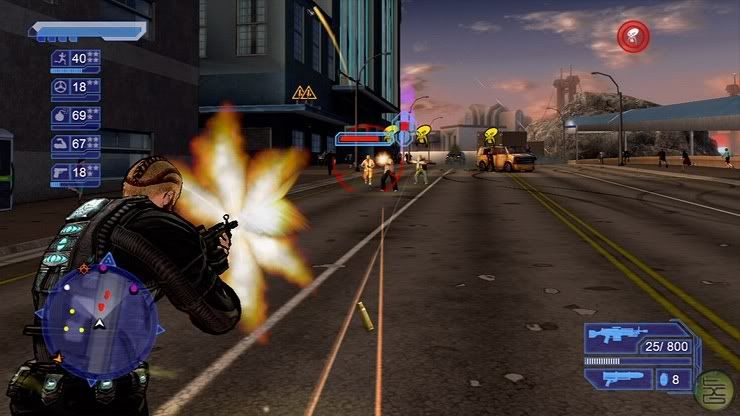
Title: Crackdown
Platform: Xbox 360
Price: $29.99 and up
ESRB Rating: M for Mature
Developer: Realtime Worlds
Publisher: Microsoft Game Studios
Age Range: 17+
BUY?: NO
While Crackdown includes exciting abilities and enjoyable gameplay, the shallowness of the game’s design keeps it from being a must-buy title. The over-the-top jumping and gunplay are thrilling at first but lose their luster after several hours. Driving is a chore with vehicles only becoming of interest towards the end of the game. Because the player’s superhuman abilities peak very early, there is nothing more to work towards after the player has maximized his or her skill set. Crackdown is decent but fails to use its unique game mechanics to their full extent. Curious gamers should check it out with a rental.
Summary:
Street gangs have run amok in Pacific City. With law enforcement hopelessly overextended, the newly formed Agency turns to its genetically enhanced super soldiers to turn the tide in the war on crime. The player will develop their skills as they chip away at the gangs’ infrastructures. By taking down gang bosses, the player will weaken the defenses of the each gang’s kingpin in order to release Pacific City from the grip of organized crime once and for all.
Total Hours of Play:
Most players will finish Crackdown in less than 15 hours. This may vary depending on how much time one spends upgrading skills that are not entirely necessary to winning the game. By focusing entirely on improving their strength and firearms capabilities, a player may defeat the final boss in less than 12.
Difficulty: EASY- MEDIUM
Crackdown is made easy by the pitiful enemy intelligence programming and the ability of the player to simply run past most of the enemies. Early bosses will be problematic due to the fact the player will not have a well-developed skill set when taking them on. When the player maximizes his or her skills, even the most menacing gang stronghold can be dealt with in a matter of minutes. Some later bosses prove difficult because of their inexhaustible armies of overpowered henchmen.
Family Factor:
Crackdown is cartoony in appearance but contains a great deal of adult content. Criminals can be dealt with in a number of brutal ways. While there is very little blood and no gore to speak of, bodies of fallen criminals plummet from buildings like limp dolls and are thrown violently by nearby explosions. The characters in the game also shout obscenities when combat ensues. Crackdown looks and plays like an interactive, adult-themed comic book. It should only be purchased for adults and older teens.
Review:
Crackdown has succeeded in taking the popular open-world formula of the Grand Theft Auto series and has successfully added several larger-than-life character abilities to create what is perhaps one of the best superhero games to date. The entirety of Pacific City is open for exploration from the beginning of the game. Only the player’s skills and ingenuity stand between the player and bringing order to the streets. However, the core gameplay is riddled with unforgivable flaws. Crackdown’s brevity, sloppiness and lack of content will turn off many prospective players.
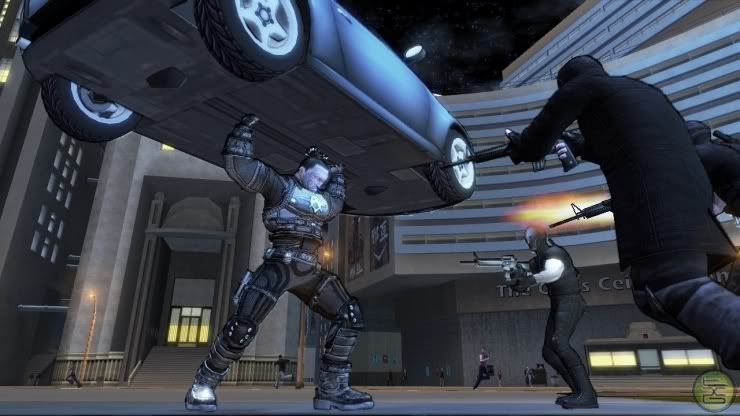 Crackdown’s stylized graphics is one of its most unique features. The art style appears at first to be hand-drawn. Every character and object is bordered by a heavy black line, which adds an interesting comic-like feel to the game. Pacific City is beautifully rendered and surprisingly intricate. In addition, the draw distance (the distance the player can see from a high vantage point without the landscape becoming blurry) is quite impressive. It should also be mentioned that the game never has to pause to load sections of the landscape as the player travels. Considering the size of the environment, this is an admirable feat.
Crackdown’s sound is nothing out of the ordinary. The weapons and explosions all sound alike. The greatest disappointment here is the sheer lack of music. Music only plays when the player enters a vehicle, an act which will be rare for most players. Even when driving, the musical selections all share a droning, falsified techno feel. To make matters worse, every musical track is accompanied by an irritating on-screen popup that displays the artist, album, and record label of the song being played. This annoyance cannot be turned off and takes away from the already below-average musical selections.
Fortunately, Crackdown’s gameplay is mostly fun and interesting. The abilities are excellently rendered and are a blast to use. Throwing buses at bad guys never really gets old and jumping from rooftop to rooftop is one of the most amusing and efficient ways to traverse the cityscape. Explosions are exhilarating and
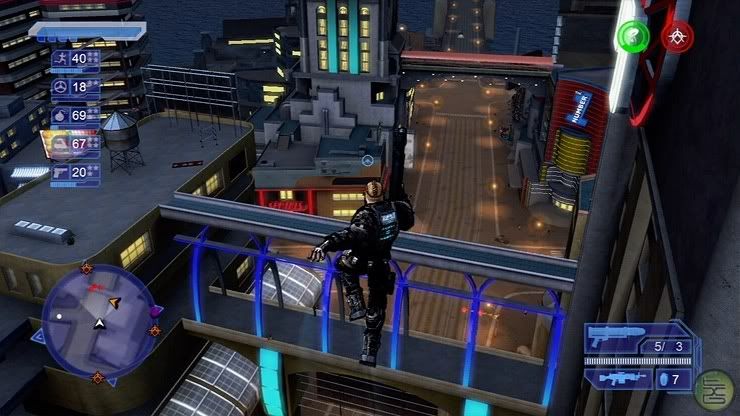 absurdly powerful. Everything facet of the game is ridiculously over-done, lending the game a welcome action-movie flavor. Sadly, even the best concepts in Crackdown are needlessly hampered by the sloppy design.
While firearms function reasonably well, the targeting system that Crackdown uses is eerily reminiscent of the troubled control scheme used by Grand Theft Auto III. Targeting enemies is frustrating and difficult. During firefights, my character would seldom zoom in on the target I wanted. I often found myself firing on fellow police officers, civilians, or dead criminals because the targeting system chose to lock onto a friendly (or deceased) character as opposed to a hostile. I also found that the superhuman abilities, while thrilling at first, reached their full potential in just a few short hours. With my character at full strength, it made more sense to avoid enemies than to engage them. The skills are too easy to upgrade and peak too quickly. I felt no incentive to approach tasks in ways that would improve my skill set because my character was already at his best. Crackdown fails to reward players beyond the first few hours of play.
Crackdown’s greatest flaw is in its emptiness. Pacific City is sprawling and remarkably accessible but lacks variety. Outside taking down gang bosses there is little else to do. The city contains multiple races that help the player to boost their skills. However, these brief time trials are pointless once the player has reached their height. Another of Crackdown’s greatest pitfalls is its lack of core gameplay. The game itself maxes out at a scant 15 hours. When the player takes down a gang’s kingpin, the entire gang permanently disappears from the streets. Once gangs disappear, there is no longer anything to do in entire segments of the city. Once the last kingpin is taken care of, there is nothing left to do in the game aside from a few mediocre time trials and an abysmal cooperative mode that is only available via Xbox LIVE.
Overall, Crackdown is a game that delivers exactly what it promises. Explosions are plentiful, enemies are abundant, and the mutant-like skills of the game’s protagonists are beyond comparison. Crackdown does well in developing its unique superhero abilities but fails to round out the rest of its gameplay.
Related Games:
The Grand Theft Auto series (multiple platforms), Mercenaries (Xbox, PS2), Lost Planet: Extreme Condition (Xbox 360, PS3, PC), Saints Row (Xbox 360)
Tuesday, April 15, 2008
Apollo Justice: Ace Attorney (DS)
Title: Apollo Justice: Ace Attorney
Platform: Nintendo DS
Price: $29.99
ESRB Rating: T for Teen (13+)
Developer: Capcom
Publisher: Capcom
Age Range: 13+. ESRB rating very appropriate.
Buy?: Depends. If you've been following the Ace Attorney series from the Phoenix Wright games, you will get your money's worth. However, if this is your fist Ace Attorney game, it will be more worthwhile to start at the beginning with Phoenix Wright: Ace Attorney.
Summary: The sequel to the three-game-long series Phoenix Wright in which a new attorney named Apollo Justice takes the spotlight in four new cases. Like its predecessors this game is an interactive novel.
Family Factor: All cases are murder cases and with that comes investigating crime scenes that usually have blood. One character gets shot and shortly thereafter dies in front of you, but not in an overly dramatized way. One case involves a panty thief, who steals girls panties off the clothes lines (when the thief is discovered you find his intentions aren’t perverted or in any way sexually deviant… just misguided and bizarre). Game involves an interesting underlying theme of ethics.
Review:
An Ace Attorney game without Phoenix Wright?!
OBJECTION!
All cheesy lead-ins aside, the passing of the torch from one rookie attorney to another went surprisingly smooth (which is way more than we can say for the 2008 Olympic torch). Probably because the lovable Phoenix Wright himself was brought into Apollo Justice, and helped foster this transition from his legacy to Apollo’s shaky beginnings.
To all the wackiness and outlandishness that is traditionally attached to this series’s storyline, the game had a fairly solemn underlying theme, which is an oftentimes-elusive creature in videogames. The Phoenix Wright games focused on finding and presenting the right evidence to determine the truth—in the fictional court, evidence was everything—the only thing that can prove your case. Apollo Justice, however, toys with the idea that the law should not be as absolute, and evidence alone may not be enough to determine rightful decision of innocence or guilt. It’s an interesting point and one I hope to see more of in sequels.
And that’s about where the seriousness of the game ends.
Crazy characters and the most twisted turnabouts are definitely back in full force, even with a few heart-warming cameos and throwbacks to Phoenix’s days. Apollo Justice’s cast of characters are even quirkier and in some cases, more obnoxious than Phoenix’s former entourage. For example, there’s the pretentious grad student who can’t say anything in less than five full boxes of text and the overly-aggressive, gangster wannabe Wocky Kitaki, who has the same tendencies as the grad student but in a louder and more irritating way.
Before I launch into a full critique of the main characters and make this into an analyses rather than a review, I suppose I should move on to gameplay and the other important things that make the game tick. Continuing with the traditional model, Apollo Justice cycles through periods of investigation and then the subsequential day in court. The simple, point-and-click investigation gameplay is unchanged, except you can’t present character profiles to people anymore. Court gameplay hasn’t changed much either, except the logic puzzles that call on you to defend your case can be aggravatingly easy. In only a few instances did I not know the exact answer or piece of evidence I was supposed to present. More gimmicky tools are used to solve cases—a soundboard and an assortment of “scientific” solvents and devices—but fail to add any difficulty. The penalties for answering these puzzles wrong have been significantly reduced, as the game replenishes your penalty counter almost every time you re-enter court. Although this allows you to gloriously skate your way through the game, there simply isn’t as much joy in an easy victory.
Courtroom gameplay receives a slight amount of redemption with the new ability to “perceive.” Perceiving allows Apollo to hone in on a witness’s nervous tics and twitches, and to use these telling signs to reveal information they might be hiding. This is used mostly with witness testimonies that have no outright contradictions, circling back to the theme that evidence can’t prove everything. Perceiving is interesting and fun, and the only source of difficulty in the game.
In my humble opinion, no other Ace Attorney game has been able to match the music established in the very first game. Those songs and sounds blended seamlessly with the story. But I stand by this opinion as Apollo Justice’s soundtrack was often hit or miss. Sometimes the music gelled perfectly. More often it was so-so. And more than a few instances it was, “can someone remind me why there’s such happy, upbeat music playing while I’m investigating this murder crime scene? Anyone?”
Apollo Justice, while staying true to an original, winning formula, has some pitfalls that prevents me from recommending it to people not familiar with the series. It might be more beneficial to purchase the first Phoenix Wright game, Phoenix Wright: Ace Attorney.
Related games: Phoenix Wright: Ace Attorney, Professor Layton and the Curious Village
Platform: Nintendo DS
Price: $29.99
ESRB Rating: T for Teen (13+)
Developer: Capcom
Publisher: Capcom
Age Range: 13+. ESRB rating very appropriate.
Buy?: Depends. If you've been following the Ace Attorney series from the Phoenix Wright games, you will get your money's worth. However, if this is your fist Ace Attorney game, it will be more worthwhile to start at the beginning with Phoenix Wright: Ace Attorney.
Summary: The sequel to the three-game-long series Phoenix Wright in which a new attorney named Apollo Justice takes the spotlight in four new cases. Like its predecessors this game is an interactive novel.
Family Factor: All cases are murder cases and with that comes investigating crime scenes that usually have blood. One character gets shot and shortly thereafter dies in front of you, but not in an overly dramatized way. One case involves a panty thief, who steals girls panties off the clothes lines (when the thief is discovered you find his intentions aren’t perverted or in any way sexually deviant… just misguided and bizarre). Game involves an interesting underlying theme of ethics.
Review:
An Ace Attorney game without Phoenix Wright?!
OBJECTION!
All cheesy lead-ins aside, the passing of the torch from one rookie attorney to another went surprisingly smooth (which is way more than we can say for the 2008 Olympic torch). Probably because the lovable Phoenix Wright himself was brought into Apollo Justice, and helped foster this transition from his legacy to Apollo’s shaky beginnings.
To all the wackiness and outlandishness that is traditionally attached to this series’s storyline, the game had a fairly solemn underlying theme, which is an oftentimes-elusive creature in videogames. The Phoenix Wright games focused on finding and presenting the right evidence to determine the truth—in the fictional court, evidence was everything—the only thing that can prove your case. Apollo Justice, however, toys with the idea that the law should not be as absolute, and evidence alone may not be enough to determine rightful decision of innocence or guilt. It’s an interesting point and one I hope to see more of in sequels.
And that’s about where the seriousness of the game ends.
Crazy characters and the most twisted turnabouts are definitely back in full force, even with a few heart-warming cameos and throwbacks to Phoenix’s days. Apollo Justice’s cast of characters are even quirkier and in some cases, more obnoxious than Phoenix’s former entourage. For example, there’s the pretentious grad student who can’t say anything in less than five full boxes of text and the overly-aggressive, gangster wannabe Wocky Kitaki, who has the same tendencies as the grad student but in a louder and more irritating way.
Before I launch into a full critique of the main characters and make this into an analyses rather than a review, I suppose I should move on to gameplay and the other important things that make the game tick. Continuing with the traditional model, Apollo Justice cycles through periods of investigation and then the subsequential day in court. The simple, point-and-click investigation gameplay is unchanged, except you can’t present character profiles to people anymore. Court gameplay hasn’t changed much either, except the logic puzzles that call on you to defend your case can be aggravatingly easy. In only a few instances did I not know the exact answer or piece of evidence I was supposed to present. More gimmicky tools are used to solve cases—a soundboard and an assortment of “scientific” solvents and devices—but fail to add any difficulty. The penalties for answering these puzzles wrong have been significantly reduced, as the game replenishes your penalty counter almost every time you re-enter court. Although this allows you to gloriously skate your way through the game, there simply isn’t as much joy in an easy victory.
Courtroom gameplay receives a slight amount of redemption with the new ability to “perceive.” Perceiving allows Apollo to hone in on a witness’s nervous tics and twitches, and to use these telling signs to reveal information they might be hiding. This is used mostly with witness testimonies that have no outright contradictions, circling back to the theme that evidence can’t prove everything. Perceiving is interesting and fun, and the only source of difficulty in the game.
In my humble opinion, no other Ace Attorney game has been able to match the music established in the very first game. Those songs and sounds blended seamlessly with the story. But I stand by this opinion as Apollo Justice’s soundtrack was often hit or miss. Sometimes the music gelled perfectly. More often it was so-so. And more than a few instances it was, “can someone remind me why there’s such happy, upbeat music playing while I’m investigating this murder crime scene? Anyone?”
Apollo Justice, while staying true to an original, winning formula, has some pitfalls that prevents me from recommending it to people not familiar with the series. It might be more beneficial to purchase the first Phoenix Wright game, Phoenix Wright: Ace Attorney.
Related games: Phoenix Wright: Ace Attorney, Professor Layton and the Curious Village
Tuesday, April 8, 2008
Star Wars Battlefront II (PS2)
reviewer: Will Kirschner
Title: Stars Wars Battlefront II
Platform: Playstation 2, Playstation Portable (PSP), Xbox, Xbox 360, PC
Price: $19.99
ESRB Rating: T for Teen (13+)
Developer: Pandemic
Publisher: LucasArts
Age Range: 8+
Buy? Three questions you need to ask yourself before you answer this all-important question: Do you like Star Wars? Do you enjoy shooting games? Do you have friends? If you answered yes to more than one of these, this game is a must have. However, if you do not have anyone to play it with you might just want to rent it.
Summary: The storyline follows a veteran clone/stormtrooper through the events of Star Wars: Episode III to Episode VI. You will experience familiar things to Star Wars fans like the battle of Endor and also deal with side-plots like putting down a revolt on Naboo. You serve as part of the 501th legion, known to the most serious of Star Wars fans as Vader's personal legion, things are guaranteed to get hot and heavy.
Difficulty: This game's major flaw lies in the difficulty of the the two modes. Easy is a joke after 15 minutes of gameplay and hard gives even the most experienced players trouble. Since the prime joy of the game lies in the multi-player realm it isn't such a deal but it makes this game less of a classic.
Learning Curve: There is a very slight learning curve to this game. Basically, you just need to learn the controls to get the game down.
Total Hours of Play: 6 to finish the campaign on easy, 10 to finish the campaign on hard. Limitless hours of play in the multi-player mode.
Family Factor: This is a game that the whole family can play. Disregard the T-rating this game has simulated violence, that begins and ends with guys getting shot and crumpling(no blood, no gross noise, very clean violence). The plot themes are not adult either.
Review:
This game is, in my mind is the pinnacle of first-person shooter (FPS) for the PlayStation 2. It combines a winning format of Star Wars and action gaming. The system battlefront uses is unique for combat games. The teams start out with an equal number of troops and then they fight until one team destroys all of their troops. Now, there won't be hundreds of soldiers on the field but about forty soldiers give the game the feel of a giant battle. The battles are amazing in their simplicity. The controls are intuitive and make playing this game an even more enjoyable experience. The varying modes of play are nice. For example, Galactic Conquest brings the option of buying all your units and their upgrades and choosing your attacks with the same gameplay. You use credits you earn for victories to buy troop types and bonuses for units, starting with the most basic unit of stormtroopers and buying more advanced units as you progress. This can take six hours for you and your friends to finish, providing a night of fierce competition. There is an all-heroes mode, capture the flag, assault and a new mode which allows you to hunt some memorable beasts like the sand people or the giant spider like beasts from the Geonosian arena in Episode II.
Problems with this game are few but are big. The single-player experience would be best experienced in a single rent. The campaign is not exactly riveting and there is no character development to speak of. Playing this game with a friend, however, makes up for this because there is nothing better than the teamwork of taking the wheel of an AT-AT while a friend blows the rebel generator. The experience system is good but could use more bonuses. Most of the weapons have their own challenge, and make you want to try every class. The rank system is cool just because it gives you bragging rights.
Two things that are new from the old system are heroes and space combat. There is nothing cooler than blasting a TIE-Fighter while dodging turbolaser blasts from a Star Destroyer. There is a slight problem with the ships all being basically cookie-cutter clones in ability. If an X-Wing and a TIE could take the same damage the Rebellion would have ended in a week. I know that this presented a problem for the developers but I wish they would have gone a different way with it. For example, three TIES equal one X-Wing in point value. Making the ships all uniform is goofy,because to the hardcore Star Wars fan, TIE's should be falling faster than villains in a Rambo movie. The heroes are classic Star Wars canon stars like Vader,Yoda and my personal favorite Boba Fett. This game did a great thing with their huge amount of heroes and varying weapons. Getting to fry Luke Skywalker with a flamethrower solved years of issues I had with the original Star Wars. The enemy heroes can drive you insane with their ridiculous AI on the tougher mode.
This is another game that is a most have for the FPS lover. It is currently in my top ten list and I still play it weekly. A must have for any fan of Star Wars and a good pick for anyone else.
Related Games: Battlefront I, The Battlefield series, most FPS(first person shooters
Title: Stars Wars Battlefront II
Platform: Playstation 2, Playstation Portable (PSP), Xbox, Xbox 360, PC
Price: $19.99
ESRB Rating: T for Teen (13+)
Developer: Pandemic
Publisher: LucasArts
Age Range: 8+
Buy? Three questions you need to ask yourself before you answer this all-important question: Do you like Star Wars? Do you enjoy shooting games? Do you have friends? If you answered yes to more than one of these, this game is a must have. However, if you do not have anyone to play it with you might just want to rent it.
Summary: The storyline follows a veteran clone/stormtrooper through the events of Star Wars: Episode III to Episode VI. You will experience familiar things to Star Wars fans like the battle of Endor and also deal with side-plots like putting down a revolt on Naboo. You serve as part of the 501th legion, known to the most serious of Star Wars fans as Vader's personal legion, things are guaranteed to get hot and heavy.
Difficulty: This game's major flaw lies in the difficulty of the the two modes. Easy is a joke after 15 minutes of gameplay and hard gives even the most experienced players trouble. Since the prime joy of the game lies in the multi-player realm it isn't such a deal but it makes this game less of a classic.
Learning Curve: There is a very slight learning curve to this game. Basically, you just need to learn the controls to get the game down.
Total Hours of Play: 6 to finish the campaign on easy, 10 to finish the campaign on hard. Limitless hours of play in the multi-player mode.
Family Factor: This is a game that the whole family can play. Disregard the T-rating this game has simulated violence, that begins and ends with guys getting shot and crumpling(no blood, no gross noise, very clean violence). The plot themes are not adult either.
Review:
This game is, in my mind is the pinnacle of first-person shooter (FPS) for the PlayStation 2. It combines a winning format of Star Wars and action gaming. The system battlefront uses is unique for combat games. The teams start out with an equal number of troops and then they fight until one team destroys all of their troops. Now, there won't be hundreds of soldiers on the field but about forty soldiers give the game the feel of a giant battle. The battles are amazing in their simplicity. The controls are intuitive and make playing this game an even more enjoyable experience. The varying modes of play are nice. For example, Galactic Conquest brings the option of buying all your units and their upgrades and choosing your attacks with the same gameplay. You use credits you earn for victories to buy troop types and bonuses for units, starting with the most basic unit of stormtroopers and buying more advanced units as you progress. This can take six hours for you and your friends to finish, providing a night of fierce competition. There is an all-heroes mode, capture the flag, assault and a new mode which allows you to hunt some memorable beasts like the sand people or the giant spider like beasts from the Geonosian arena in Episode II.
Problems with this game are few but are big. The single-player experience would be best experienced in a single rent. The campaign is not exactly riveting and there is no character development to speak of. Playing this game with a friend, however, makes up for this because there is nothing better than the teamwork of taking the wheel of an AT-AT while a friend blows the rebel generator. The experience system is good but could use more bonuses. Most of the weapons have their own challenge, and make you want to try every class. The rank system is cool just because it gives you bragging rights.
Two things that are new from the old system are heroes and space combat. There is nothing cooler than blasting a TIE-Fighter while dodging turbolaser blasts from a Star Destroyer. There is a slight problem with the ships all being basically cookie-cutter clones in ability. If an X-Wing and a TIE could take the same damage the Rebellion would have ended in a week. I know that this presented a problem for the developers but I wish they would have gone a different way with it. For example, three TIES equal one X-Wing in point value. Making the ships all uniform is goofy,because to the hardcore Star Wars fan, TIE's should be falling faster than villains in a Rambo movie. The heroes are classic Star Wars canon stars like Vader,Yoda and my personal favorite Boba Fett. This game did a great thing with their huge amount of heroes and varying weapons. Getting to fry Luke Skywalker with a flamethrower solved years of issues I had with the original Star Wars. The enemy heroes can drive you insane with their ridiculous AI on the tougher mode.
This is another game that is a most have for the FPS lover. It is currently in my top ten list and I still play it weekly. A must have for any fan of Star Wars and a good pick for anyone else.
Related Games: Battlefront I, The Battlefield series, most FPS(first person shooters
Tuesday, April 1, 2008
The Orange Box (Xbox 360)
Reviewer: Erich Hiner
Title: The Orange Box (Xbox 360)
Platforms: Xbox 360, Playstation 3, PC
Price: $59.99
ESRB Rating: M for Mature
Developer: Valve Corporation
Publisher: Valve Corporation
Age Range: 17+
Buy?: YES
Because The Orange Box is essentially five games for the price of one, the value of this product cannot be overstated. Each game stands well on its own while some suffer from a few forgivable mishaps. The Orange Box includes a great shooter, a fantastic puzzler, and an off-the-wall multiplayer game. Five great games for the price of one. Enough said.
Summary:
The Orange Box is a collection of games developed by the Valve Corporation that functions more as an anthology of the company’s greatest hits rather than a single piece of software. Click here to read descriptions of each of the five games.
Total Hours of Play:
Half Life 2, Half Life 2: Episodes 1 and 2, and Portal will clock in at roughly 20 hours. Due to its multiplayer nature, Team Fortress 2 can be played for any length of time.
Difficulty: MEDIUM to HIGH
Most of the games in the collection are appropriately difficult for their target audience. Players who have experience with first-person shooters will find most of the fighting and puzzle solving to be exciting and balanced. However, it should be said that certain segments of some of the games in The Orange Box seem almost unfairly difficult. While the opening levels of Half Life 2 are simple and fun, the final level of Half Life 2: Episode 2 is aggravating at best and poorly designed at worst. Players should also be aware that the unorthodox puzzles of Portal may prove difficult for some gamers.
Learning Curve: MEDIUM to HIGH
As The Orange Box is a collection of games, the learning curve varies based on which game is being played. Most players should find Half Life 2’s control scheme and mechanics to be simple and textbook. The only difficulty some players will find is in mastering the unique physics-based puzzles in the game. The controls for Team Fortress 2 are similarly simplistic to allow for greater ease of play. Portal, more so than any other game in the collection, will cause confusion for many players. While the game functions flawlessly, it may take some gamers a while to wrap their minds around the concept of the portal as it applies to movement and game mechanics.
Family Factor:
This collection is not for children of any age. Half Life 2 contains graphic violence and strong language. There are many points throughout the game where the player is forced to fight “zombies”, humans who have been corrupted by a parasitic animal. The firefights that ensue include glimpses of burning corpses, dismembered limbs, and horrific images of maimed human bodies. Half Life 2: Episodes 1 and 2 include a similar amount of gore and adult content. Parents should also be aware that the game’s dialogue includes some subdued sexual references. Team Fortress 2, while cartoonish in appearance, includes intense combat and scenes of animated gore. Portal is only game in The Orange Box to receive a rating of T for Teen from the ESRB. Nevertheless, parents should know that the game includes brief sequences of violence and a very dark, adult-oriented sense of humor.
Review:
Coming out years after the initial launch of Half Life 2, The Orange Box accomplishes exactly what it was designed to do. In bundling the original game with two expansion packs, a multiplayer game and an experimental project, Valve has given gamers what is perhaps the best deal of the current console generation. Each game functions well on its own. When taken as a whole, the collection truly stands out. Although some of the games suffer from some minor missteps, the transfer from PC to console has been smooth.
The original Half Life 2 has been brought to the Xbox 360 in all its glory. Players will be treated to one of the most gripping storylines in gaming as they blast and think their way through this enjoyable epic. The game’s weapons are standard fare with an arsenal of pistols, shotguns and rifles. Even when using these shooter standbys, the action is always sharp and exciting due to the excellent enemy intelligence programming. Enemy soldiers will actively flank your position and use the environment against you. Where the game takes a strangely satisfying turn for the unorthodox is in the introduction of what is perhaps the greatest use of the game’s real-time physics: the gravity gun. Using this device, players can use grab large objects and heave them at their adversaries. Sheet metal can be used as mobile cover while leaking oil barrels can serve as ad-hoc grenades. This simple weapon is what gives Half Life 2 much of its charm. Although the game’s graphics may be considered slightly outdated, the voice acting of the characters is easily some of the best in the industry. The music, which plays only rarely, is appropriate to the sci-fi setting. Where Half Life 2 falls short is in its unreliable vehicle controls that are the result of the game’s transition from the PC to the Xbox 360.The simplistic and frustrating control style will confuse and fluster many players. As well as these segments functioned on the PC, they translated very poorly to the 360 controller. That said, the game is mostly enjoyable with only a few hiccups to be found in the core gameplay.
Half Life 2: Episodes 1 and 2 function as direct extensions of the original game. As such, they share many of the successes and failures of their predecessor. The story fleshes out through well-written dialogue and the action remains fresh. Although each of these expansions flows very well from the original game and into one another, they should be considered separate games due to the fact that the player is forced to begin each with only the gravity gun at their disposal. The sound quality and music are identical to the original game. As fun as these installments can be, I found that the level design paled in comparison to that of Half Life 2. Levels were often as simple as running across open ground a number of times or avoiding a formidable enemy until a more powerful weapon became available. Both of these additions serve to continue the narrative that Half Life 2 began and both accomplish this task. As individual games, they simply lack the depth of their source material. As extensions of Half Life 2, both are solid experiences that expand an already competent game.
Every game in The Orange Box is expertly rendered and enjoyable. Only Portal, however, shines as a true gaming masterpiece. The graphics are decent and the music sets a superb mood. What Portal lacks in length (the entire game clocks in at roughly 2.5 hours) it more than makes up for in innovative gameplay. The game is based around the idea of a portal and how it would function if such a thing actually existed. Using the same physics engine as Half Life 2, the developers of Portal used this deceivingly simple device as the basis for what may be one of the greatest creative leaps in recent gaming history. The only tool at the disposal of the player is the portal gun, a device that allows the player to open the beginning and end of a portal wherever they wish. Once the players master this gadget, the appearance of the game shifts considerably. Need to climb that cliff? Shoot a portal on the wall near the top. Need to reach that platform? Shoot a portal on the ceiling above it and fall to your goal. Need to get over that wall? The solution is as simple as “falling” over it. The concept of portal is guaranteed to stretch the limits of the player’s understanding of physics and space. Not surprisingly, the learning curve for this off-beat puzzler is quite high. The game requires that the player think about their world in new ways and use the realistic physics as a tool to overcome obstacles. The game does not include any fighting in the style of Half Life. Rather, Portal asks the player to use the tools at their disposal to think their way through the puzzles that this M.C. Escher-esque game lays before them. The fun of Portal is only helped by the disturbing and hilarious remarks made by GlaDOS, the game’s antagonist. The signature sense of humor of the developers is alive and well in Portal as the most ominous situation is always made comical by the robotic drawl of this eerily emotionless machine. Many of the lines uttered during the final sequence of the game help make the confrontation with GlaDOS one of the most memorable moments of any game in recent memory. With its outstanding gameplay and delightfully dark sense of humor, Portal is easily the crown jewel of The Orange Box.
The last game in The Orange Box, Team Fortress 2, is a stark contrast to the dark, foreboding worlds of Half Life 2 and Portal. Functioning as The Orange Box’s multiplayer appeal, this cartoony game has taken a number of different approaches to the standard team-based shooting games. Unlike many of its fellow shooters, Team Fortress 2 asks that the player select a “class” at the beginning of every match. Each class fills a different role and allows the team to function as a single unit. The quick Scout is responsible for recovering enemy flags while the Demo Man is adept at placing explosive traps for his foes. The game is designed with teams in mind. Players must work together in order to achieve victory. Valve has done an excellent job of balancing the classes so that no one type can dominate the battlefield. However, I found the class system to be somewhat limiting. Players are essentially stuck with a class until they are killed. Changing classes mid-fight requires that players give up a life. Part of the fun of multiplayer shooting games is being able to adapt to changing situations. If my base is infiltrated, then my Sniper, with his low health and weak sidearm, is next to useless. Throwing down my rifle for a shotgun is out of the question. Furthermore, many of the stages lack inspiration and seem ill-designed for some of the classes. Snipers are sometimes useless due to the lack of hiding places and Medics, while essential to the team effort, are cannon fodder when caught alone. The kooky art style and humorous tone of the game help to rescue it from obscurity, but the design flaws of the levels and the limited roles of the classes drag down Team Fortress 2. Many players will also be disappointed to find that the game can only be played via Xbox LIVE or a local area network. There is no split-screen play. As a stand-alone title, Team Fortress 2 is worth a few fun hours before the novelty ultimately wears off. As a part of The Orange Box, however, it satisfies the need for a fun, albeit shallow, multiplayer experience.
As a developer, Valve has a long-standing reputation of giving gamers a solid, innovative experience. No better is this expressed than by The Orange Box. This collection of games exhibits Valve’s creative prowess and professionalism like no other product on the market. Those who have not experience the greatness of Half Life 2 should certainly make an effort to acquire this compilation. When one factors in all the other games, the value of this package is obvious. The masterpiece of Portal along with the original Half Life 2 is easily worth the price of this excellent anthology. The Orange Box is all about value. Each game in the set easily stands on its own as a sound experience. As a whole, The Orange Box is a solid edition to any gaming library.
Related Games: Half Life (PC), Team Fortress (PC), Time Splitters: Future Perfect (Xbox, PS2, Gamecube),
Title: The Orange Box (Xbox 360)
Platforms: Xbox 360, Playstation 3, PC
Price: $59.99
ESRB Rating: M for Mature
Developer: Valve Corporation
Publisher: Valve Corporation
Age Range: 17+
Buy?: YES
Because The Orange Box is essentially five games for the price of one, the value of this product cannot be overstated. Each game stands well on its own while some suffer from a few forgivable mishaps. The Orange Box includes a great shooter, a fantastic puzzler, and an off-the-wall multiplayer game. Five great games for the price of one. Enough said.
Summary:
The Orange Box is a collection of games developed by the Valve Corporation that functions more as an anthology of the company’s greatest hits rather than a single piece of software. Click here to read descriptions of each of the five games.
Total Hours of Play:
Half Life 2, Half Life 2: Episodes 1 and 2, and Portal will clock in at roughly 20 hours. Due to its multiplayer nature, Team Fortress 2 can be played for any length of time.
Difficulty: MEDIUM to HIGH
Most of the games in the collection are appropriately difficult for their target audience. Players who have experience with first-person shooters will find most of the fighting and puzzle solving to be exciting and balanced. However, it should be said that certain segments of some of the games in The Orange Box seem almost unfairly difficult. While the opening levels of Half Life 2 are simple and fun, the final level of Half Life 2: Episode 2 is aggravating at best and poorly designed at worst. Players should also be aware that the unorthodox puzzles of Portal may prove difficult for some gamers.
Learning Curve: MEDIUM to HIGH
As The Orange Box is a collection of games, the learning curve varies based on which game is being played. Most players should find Half Life 2’s control scheme and mechanics to be simple and textbook. The only difficulty some players will find is in mastering the unique physics-based puzzles in the game. The controls for Team Fortress 2 are similarly simplistic to allow for greater ease of play. Portal, more so than any other game in the collection, will cause confusion for many players. While the game functions flawlessly, it may take some gamers a while to wrap their minds around the concept of the portal as it applies to movement and game mechanics.
Family Factor:
This collection is not for children of any age. Half Life 2 contains graphic violence and strong language. There are many points throughout the game where the player is forced to fight “zombies”, humans who have been corrupted by a parasitic animal. The firefights that ensue include glimpses of burning corpses, dismembered limbs, and horrific images of maimed human bodies. Half Life 2: Episodes 1 and 2 include a similar amount of gore and adult content. Parents should also be aware that the game’s dialogue includes some subdued sexual references. Team Fortress 2, while cartoonish in appearance, includes intense combat and scenes of animated gore. Portal is only game in The Orange Box to receive a rating of T for Teen from the ESRB. Nevertheless, parents should know that the game includes brief sequences of violence and a very dark, adult-oriented sense of humor.
Review:
Coming out years after the initial launch of Half Life 2, The Orange Box accomplishes exactly what it was designed to do. In bundling the original game with two expansion packs, a multiplayer game and an experimental project, Valve has given gamers what is perhaps the best deal of the current console generation. Each game functions well on its own. When taken as a whole, the collection truly stands out. Although some of the games suffer from some minor missteps, the transfer from PC to console has been smooth.
The original Half Life 2 has been brought to the Xbox 360 in all its glory. Players will be treated to one of the most gripping storylines in gaming as they blast and think their way through this enjoyable epic. The game’s weapons are standard fare with an arsenal of pistols, shotguns and rifles. Even when using these shooter standbys, the action is always sharp and exciting due to the excellent enemy intelligence programming. Enemy soldiers will actively flank your position and use the environment against you. Where the game takes a strangely satisfying turn for the unorthodox is in the introduction of what is perhaps the greatest use of the game’s real-time physics: the gravity gun. Using this device, players can use grab large objects and heave them at their adversaries. Sheet metal can be used as mobile cover while leaking oil barrels can serve as ad-hoc grenades. This simple weapon is what gives Half Life 2 much of its charm. Although the game’s graphics may be considered slightly outdated, the voice acting of the characters is easily some of the best in the industry. The music, which plays only rarely, is appropriate to the sci-fi setting. Where Half Life 2 falls short is in its unreliable vehicle controls that are the result of the game’s transition from the PC to the Xbox 360.The simplistic and frustrating control style will confuse and fluster many players. As well as these segments functioned on the PC, they translated very poorly to the 360 controller. That said, the game is mostly enjoyable with only a few hiccups to be found in the core gameplay.
Half Life 2: Episodes 1 and 2 function as direct extensions of the original game. As such, they share many of the successes and failures of their predecessor. The story fleshes out through well-written dialogue and the action remains fresh. Although each of these expansions flows very well from the original game and into one another, they should be considered separate games due to the fact that the player is forced to begin each with only the gravity gun at their disposal. The sound quality and music are identical to the original game. As fun as these installments can be, I found that the level design paled in comparison to that of Half Life 2. Levels were often as simple as running across open ground a number of times or avoiding a formidable enemy until a more powerful weapon became available. Both of these additions serve to continue the narrative that Half Life 2 began and both accomplish this task. As individual games, they simply lack the depth of their source material. As extensions of Half Life 2, both are solid experiences that expand an already competent game.
Every game in The Orange Box is expertly rendered and enjoyable. Only Portal, however, shines as a true gaming masterpiece. The graphics are decent and the music sets a superb mood. What Portal lacks in length (the entire game clocks in at roughly 2.5 hours) it more than makes up for in innovative gameplay. The game is based around the idea of a portal and how it would function if such a thing actually existed. Using the same physics engine as Half Life 2, the developers of Portal used this deceivingly simple device as the basis for what may be one of the greatest creative leaps in recent gaming history. The only tool at the disposal of the player is the portal gun, a device that allows the player to open the beginning and end of a portal wherever they wish. Once the players master this gadget, the appearance of the game shifts considerably. Need to climb that cliff? Shoot a portal on the wall near the top. Need to reach that platform? Shoot a portal on the ceiling above it and fall to your goal. Need to get over that wall? The solution is as simple as “falling” over it. The concept of portal is guaranteed to stretch the limits of the player’s understanding of physics and space. Not surprisingly, the learning curve for this off-beat puzzler is quite high. The game requires that the player think about their world in new ways and use the realistic physics as a tool to overcome obstacles. The game does not include any fighting in the style of Half Life. Rather, Portal asks the player to use the tools at their disposal to think their way through the puzzles that this M.C. Escher-esque game lays before them. The fun of Portal is only helped by the disturbing and hilarious remarks made by GlaDOS, the game’s antagonist. The signature sense of humor of the developers is alive and well in Portal as the most ominous situation is always made comical by the robotic drawl of this eerily emotionless machine. Many of the lines uttered during the final sequence of the game help make the confrontation with GlaDOS one of the most memorable moments of any game in recent memory. With its outstanding gameplay and delightfully dark sense of humor, Portal is easily the crown jewel of The Orange Box.
The last game in The Orange Box, Team Fortress 2, is a stark contrast to the dark, foreboding worlds of Half Life 2 and Portal. Functioning as The Orange Box’s multiplayer appeal, this cartoony game has taken a number of different approaches to the standard team-based shooting games. Unlike many of its fellow shooters, Team Fortress 2 asks that the player select a “class” at the beginning of every match. Each class fills a different role and allows the team to function as a single unit. The quick Scout is responsible for recovering enemy flags while the Demo Man is adept at placing explosive traps for his foes. The game is designed with teams in mind. Players must work together in order to achieve victory. Valve has done an excellent job of balancing the classes so that no one type can dominate the battlefield. However, I found the class system to be somewhat limiting. Players are essentially stuck with a class until they are killed. Changing classes mid-fight requires that players give up a life. Part of the fun of multiplayer shooting games is being able to adapt to changing situations. If my base is infiltrated, then my Sniper, with his low health and weak sidearm, is next to useless. Throwing down my rifle for a shotgun is out of the question. Furthermore, many of the stages lack inspiration and seem ill-designed for some of the classes. Snipers are sometimes useless due to the lack of hiding places and Medics, while essential to the team effort, are cannon fodder when caught alone. The kooky art style and humorous tone of the game help to rescue it from obscurity, but the design flaws of the levels and the limited roles of the classes drag down Team Fortress 2. Many players will also be disappointed to find that the game can only be played via Xbox LIVE or a local area network. There is no split-screen play. As a stand-alone title, Team Fortress 2 is worth a few fun hours before the novelty ultimately wears off. As a part of The Orange Box, however, it satisfies the need for a fun, albeit shallow, multiplayer experience.
As a developer, Valve has a long-standing reputation of giving gamers a solid, innovative experience. No better is this expressed than by The Orange Box. This collection of games exhibits Valve’s creative prowess and professionalism like no other product on the market. Those who have not experience the greatness of Half Life 2 should certainly make an effort to acquire this compilation. When one factors in all the other games, the value of this package is obvious. The masterpiece of Portal along with the original Half Life 2 is easily worth the price of this excellent anthology. The Orange Box is all about value. Each game in the set easily stands on its own as a sound experience. As a whole, The Orange Box is a solid edition to any gaming library.
Related Games: Half Life (PC), Team Fortress (PC), Time Splitters: Future Perfect (Xbox, PS2, Gamecube),
Monday, March 31, 2008
Lumines II (PSP)
Reviewer: Meghan Ventura
Title: Lumines II
Platform: Playstation Portable
Price: $19.99
ESRB Rating: T for Teen (13+)
Developer: Q Entertainment
Publisher: Q Entertainment / Buena Vista Games
Age Range: 12+
Buy?
Maybe. If you already have some version of Lumines, you probably don’t need this one unless you’re a diehard fan who wants some new tunes to play to. However, if you’re new to Lumines and looking for a solid puzzle game, $19.99 is a great value for this little package.
Summary: A puzzle game with falling blocks that requires players to make same-colored squares, rather than lines like in more traditional puzzle games. See the video below for a clearer picture of how Lumines works. (Note: Video footage is NOT from Your Family Games. The original video can be found at GameTrailers)
Learning curve: Initially, very steep. Maybe 30 mintues. Tutorials and logic puzzles really help you find your footing. My first puzzle, I hardly lasted five minutes, but now I can play for at least 40+ minutes before I meet the doom of a full screen of blocks. To a certain degree, Lumines is about practice and the more you practice the more you improve.
Family Factor: Curse words have been omitted from any songs with bad language. Some of the puzzle stages’ backgrounds have the music video of that particular song playing in the background or super-surreal backgrounds for non-lyrical tracks.
Review:
The concept of Lumines is simple: use these falling two-toned blocks to make same-colored squares. Executing this idea is at first difficult, but once you figure out the most strategic ways to fit the falling blocks together, breezing through 30 minutes worth of puzzle will be a snap and the only main challenge remaining will be improving your dexterity in being able to quickly move those blocks. Lumines is indeed strange in that it’s a little more difficult to pick up than your average puzzler, but making the jump from being a good to great player is merely a matter of adeptness with the simplistic controls.
Lumines has caught my attention since its beginnings on the Playstation 2. The first time I saw it, my now-roommate was playing it, intently moving falling blocks in an impressive and unique audio-visual atmosphere created by the game.
To keep puzzles visually interesting, puzzle games typically employ changing the backgrounds and colors or shapes of the blocks (say one level might have diamonds and the next bananas depending on what the level’s theme) as you progress through different levels. Lumines takes this common practice and multiplies it to a new level. Lumines has flashy backgrounds that can include a video or moving pictures, and an accompanying tune to play along with it. The backgrounds are intriguing, distracting and sometimes surreal, ranging from a line of 6 jumping ears to simply a montage of dogs and dog-related pictures. A majority of the accompanying music has a non-vocal, techno, synthesized flair, but there are a pleasing amount of song from pop, rock, rap and alternative genres, like Gwen Stefani’s Hollaback Girl, Beck’s Black Tamborine, the Black-Eyed Peas’s “Pump It” and Missy Elliot’s Lose Control. Although the songs come from a wide spread of genres, the music is appealing, and even the sound effects, that go with laying down a block, making squares and clearing squares are pleasing in that they match the theme established by that particular level.
Clearing squares is one of the most rewarding things in the game. Once you assemble the falling blocks into a square, a vertical line called the timeline scans the puzzle from left-to-right and will clear the squares, making more room in your puzzle. The timeline accelerates and decelerates with the tempo of each song, giving each level it’s own rhythm. Leftover blocks that don’t make same-colored squares will get left behind. If not assimilated into a square, these blocks will be left behind by the timeline and build up if you’re not careful. If your puzzle continues to build up, blocks will eventually fill the screen resulting in the disappointing “Game Over.” But, when the timeline rolls over the squares, they disappear in a visually mesmerizing shower of sparks, cleansing your board and giving you a radiantly satisfied feeling. Couple this dynamic with the soothing audio and visual effects, and you’ve got an all-around enjoyable experience (once you learn how to play well, that is).
However, this is essentially what all Lumines games offer. If you have a Lumines game, you probably already have everything the game offers, unless you are a hardcore fan absolutely dieing for some new songs. The gameplay is the same and aside from the regular “survive as long as you can” play that is the core of Lumines, two forms of logic-based mini-puzzles are included (just like in Lumines I). Lumines II simply isn’t expansive or strong enough as a sequel to justify buying if you already own a Lumines game.
Also, the PSP will sometimes lag between the simultaneous level, song, and background change. The game will also slow down if you rack up an insanely huge combo including multiple squares. This slight hiccup in play isn’t a huge deal, but throws your rhythm a bit when full speed kicks back in.
The appeal of Lumines? It’s quirky, flashy, mesmerizing and oddly comforting once you get good at it. If you haven’t played Lumines before, Lumines II is a great place to jump in, especially because of that extremely attractive $20 price point for a very entertaining puzzle game. But if you’re a veteran Lumines player, Lumines II isn’t truly worth the upgrade.
Related games: Lumines (PS2), Tetris
Title: Lumines II
Platform: Playstation Portable
Price: $19.99
ESRB Rating: T for Teen (13+)
Developer: Q Entertainment
Publisher: Q Entertainment / Buena Vista Games
Age Range: 12+
Buy?
Maybe. If you already have some version of Lumines, you probably don’t need this one unless you’re a diehard fan who wants some new tunes to play to. However, if you’re new to Lumines and looking for a solid puzzle game, $19.99 is a great value for this little package.
Summary: A puzzle game with falling blocks that requires players to make same-colored squares, rather than lines like in more traditional puzzle games. See the video below for a clearer picture of how Lumines works. (Note: Video footage is NOT from Your Family Games. The original video can be found at GameTrailers)
Learning curve: Initially, very steep. Maybe 30 mintues. Tutorials and logic puzzles really help you find your footing. My first puzzle, I hardly lasted five minutes, but now I can play for at least 40+ minutes before I meet the doom of a full screen of blocks. To a certain degree, Lumines is about practice and the more you practice the more you improve.
Family Factor: Curse words have been omitted from any songs with bad language. Some of the puzzle stages’ backgrounds have the music video of that particular song playing in the background or super-surreal backgrounds for non-lyrical tracks.
Review:
The concept of Lumines is simple: use these falling two-toned blocks to make same-colored squares. Executing this idea is at first difficult, but once you figure out the most strategic ways to fit the falling blocks together, breezing through 30 minutes worth of puzzle will be a snap and the only main challenge remaining will be improving your dexterity in being able to quickly move those blocks. Lumines is indeed strange in that it’s a little more difficult to pick up than your average puzzler, but making the jump from being a good to great player is merely a matter of adeptness with the simplistic controls.
Lumines has caught my attention since its beginnings on the Playstation 2. The first time I saw it, my now-roommate was playing it, intently moving falling blocks in an impressive and unique audio-visual atmosphere created by the game.
To keep puzzles visually interesting, puzzle games typically employ changing the backgrounds and colors or shapes of the blocks (say one level might have diamonds and the next bananas depending on what the level’s theme) as you progress through different levels. Lumines takes this common practice and multiplies it to a new level. Lumines has flashy backgrounds that can include a video or moving pictures, and an accompanying tune to play along with it. The backgrounds are intriguing, distracting and sometimes surreal, ranging from a line of 6 jumping ears to simply a montage of dogs and dog-related pictures. A majority of the accompanying music has a non-vocal, techno, synthesized flair, but there are a pleasing amount of song from pop, rock, rap and alternative genres, like Gwen Stefani’s Hollaback Girl, Beck’s Black Tamborine, the Black-Eyed Peas’s “Pump It” and Missy Elliot’s Lose Control. Although the songs come from a wide spread of genres, the music is appealing, and even the sound effects, that go with laying down a block, making squares and clearing squares are pleasing in that they match the theme established by that particular level.
Clearing squares is one of the most rewarding things in the game. Once you assemble the falling blocks into a square, a vertical line called the timeline scans the puzzle from left-to-right and will clear the squares, making more room in your puzzle. The timeline accelerates and decelerates with the tempo of each song, giving each level it’s own rhythm. Leftover blocks that don’t make same-colored squares will get left behind. If not assimilated into a square, these blocks will be left behind by the timeline and build up if you’re not careful. If your puzzle continues to build up, blocks will eventually fill the screen resulting in the disappointing “Game Over.” But, when the timeline rolls over the squares, they disappear in a visually mesmerizing shower of sparks, cleansing your board and giving you a radiantly satisfied feeling. Couple this dynamic with the soothing audio and visual effects, and you’ve got an all-around enjoyable experience (once you learn how to play well, that is).
However, this is essentially what all Lumines games offer. If you have a Lumines game, you probably already have everything the game offers, unless you are a hardcore fan absolutely dieing for some new songs. The gameplay is the same and aside from the regular “survive as long as you can” play that is the core of Lumines, two forms of logic-based mini-puzzles are included (just like in Lumines I). Lumines II simply isn’t expansive or strong enough as a sequel to justify buying if you already own a Lumines game.
Also, the PSP will sometimes lag between the simultaneous level, song, and background change. The game will also slow down if you rack up an insanely huge combo including multiple squares. This slight hiccup in play isn’t a huge deal, but throws your rhythm a bit when full speed kicks back in.
The appeal of Lumines? It’s quirky, flashy, mesmerizing and oddly comforting once you get good at it. If you haven’t played Lumines before, Lumines II is a great place to jump in, especially because of that extremely attractive $20 price point for a very entertaining puzzle game. But if you’re a veteran Lumines player, Lumines II isn’t truly worth the upgrade.
Related games: Lumines (PS2), Tetris
Monday, March 17, 2008
Call of Duty 4: Modern Warfare (Xbox 360)
Reviewer: Will Kirschner
Title: Call of Duty 4: Modern Warfare
Platform: Xbox 360, Playstation 3, Windows, Mac OS X
Price: $59.99
ESRB Rating: M(17+)
Developer: Infinity Ward, Aspyr (Mac conversion)
Publisher: Activision
Age Range: 17+
Buy?
YES! This game had me from the second I turned on the console and I still can't stop thinking about it. It regarded in the same echelon as Halo 3 and rightfully so. A must buy for anyone who enjoys first-person shooters.
Summary:
The game has a dual plot storyline where you assume the roles of Sergeant “Soap” MacTavish of the 22nd SAS regiment and Sergeant Paul Jackson of the 1st USMC. The game begins with the violent overthrow and execution of President Al-Fulani by one of the, “The Horsemen of the Apocolypse,” Imran Zakehev. The horsemen are made up of Zakehev, his son Victor and the new dictator of the country Khalad Al-Asad. They pose a threat to the US and her allies with their anti-American ideals and of course nuclear weapons. Mayhem ensues.
Total Hours of Play:
5-8 hours to beat the storyline. Limitless on-line play.
Difficulty: Medium
Nothing about this game will trouble the experienced gamer with a bit of patience. However, if this is the first time you have gotten your hands on a FPS with the depth of Call of Duty 4 (COD4), this might give you some trouble. The game is the perfect amount of challenging to make fun.
Learning Curve: Medium
Not much has changed since the last installment in the Call of Duty series. Some levels have tricky bits which can tend to snag up even the most experienced player. The “iron sights” firing mode remains the same and feels almost too fluid for a video game. This has you looking down the barrel of the gun through a variety of different sites to fire.
Family Factor:
So not for kids! This game is realistically graphic when it comes to the level of violence it depicts. For example, there was a sequence where I sniped a man in the eye through my scope and he crumpled in a frighteningly human way. The game depicts a scene of what the developers think being in the blast radius of a nuke would look like. It was the most intense scene I have ever witnessed in my time as a gamer. This is definitely not a game for the younger teens in our audience.
Review:
I won't lie, this game inspired me with awe, made me laugh and I shed a few tears when it was all said and done. They finally made the decision to push the Call of Duty series out of the tired and nearly overdone WWII shooter genre and into modern war, and it could not have been a better decision.
The use of real weapons in the game and the stunning realistic graphics are absolutely breath-taking. The “iron-sight” shooting mode and the shooting mechanics in the game are down-right amazing. Iron sights differ from the conventional first person shooter, because instead of the normal aiming reticle, one pull back on the left trigger on the controller brings up a much more precise aiming mode. It is basically like if a gun was a sniper rifle at a normal range. It adds a immense level of realism to the game and is a great carry-over from the other Call of Duty games. The only drawback being that it requires you to be stationary and as we all know, a soldier only stays in one place when he is dying or killing. The gameplay feels fluid and incredibly natural. The storyline is as good as you could expect from a video game.
A minor drawback is that the storyline is too short (only 5-8 hours for a $60 game) and the characters seem a bit too type-casted. The health system, which allows you to regenerate the small amount of health you start with unlimitedly makes the game a little too easy at some points, but it helps on some of the tougher levels. The epilogue to the game is a major question mark but these are just minor issues with the game.
The online mode of the game is ridiculously amazing, challenging and fun. With everything from the classic death match to a one on classic cage match the variety in modes will keep you coming back for more. The game allows you to create customized classes, changing everything about your gun, whether it be attaching a a silencer or changing the gun's camouflage. You get Xbox achievement points for winning certain challenges which makes it all the more fun to play. The online game is a perfect ending to a perfect game.
Related Games:
The rest of the Call of Duty series, Tom Clancy's Rainbow Six series and the Socom series.
Title: Call of Duty 4: Modern Warfare
Platform: Xbox 360, Playstation 3, Windows, Mac OS X
Price: $59.99
ESRB Rating: M(17+)
Developer: Infinity Ward, Aspyr (Mac conversion)
Publisher: Activision
Age Range: 17+
Buy?
YES! This game had me from the second I turned on the console and I still can't stop thinking about it. It regarded in the same echelon as Halo 3 and rightfully so. A must buy for anyone who enjoys first-person shooters.
Summary:
The game has a dual plot storyline where you assume the roles of Sergeant “Soap” MacTavish of the 22nd SAS regiment and Sergeant Paul Jackson of the 1st USMC. The game begins with the violent overthrow and execution of President Al-Fulani by one of the, “The Horsemen of the Apocolypse,” Imran Zakehev. The horsemen are made up of Zakehev, his son Victor and the new dictator of the country Khalad Al-Asad. They pose a threat to the US and her allies with their anti-American ideals and of course nuclear weapons. Mayhem ensues.
Total Hours of Play:
5-8 hours to beat the storyline. Limitless on-line play.
Difficulty: Medium
Nothing about this game will trouble the experienced gamer with a bit of patience. However, if this is the first time you have gotten your hands on a FPS with the depth of Call of Duty 4 (COD4), this might give you some trouble. The game is the perfect amount of challenging to make fun.
Learning Curve: Medium
Not much has changed since the last installment in the Call of Duty series. Some levels have tricky bits which can tend to snag up even the most experienced player. The “iron sights” firing mode remains the same and feels almost too fluid for a video game. This has you looking down the barrel of the gun through a variety of different sites to fire.
Family Factor:
So not for kids! This game is realistically graphic when it comes to the level of violence it depicts. For example, there was a sequence where I sniped a man in the eye through my scope and he crumpled in a frighteningly human way. The game depicts a scene of what the developers think being in the blast radius of a nuke would look like. It was the most intense scene I have ever witnessed in my time as a gamer. This is definitely not a game for the younger teens in our audience.
Review:
I won't lie, this game inspired me with awe, made me laugh and I shed a few tears when it was all said and done. They finally made the decision to push the Call of Duty series out of the tired and nearly overdone WWII shooter genre and into modern war, and it could not have been a better decision.
The use of real weapons in the game and the stunning realistic graphics are absolutely breath-taking. The “iron-sight” shooting mode and the shooting mechanics in the game are down-right amazing. Iron sights differ from the conventional first person shooter, because instead of the normal aiming reticle, one pull back on the left trigger on the controller brings up a much more precise aiming mode. It is basically like if a gun was a sniper rifle at a normal range. It adds a immense level of realism to the game and is a great carry-over from the other Call of Duty games. The only drawback being that it requires you to be stationary and as we all know, a soldier only stays in one place when he is dying or killing. The gameplay feels fluid and incredibly natural. The storyline is as good as you could expect from a video game.
A minor drawback is that the storyline is too short (only 5-8 hours for a $60 game) and the characters seem a bit too type-casted. The health system, which allows you to regenerate the small amount of health you start with unlimitedly makes the game a little too easy at some points, but it helps on some of the tougher levels. The epilogue to the game is a major question mark but these are just minor issues with the game.
The online mode of the game is ridiculously amazing, challenging and fun. With everything from the classic death match to a one on classic cage match the variety in modes will keep you coming back for more. The game allows you to create customized classes, changing everything about your gun, whether it be attaching a a silencer or changing the gun's camouflage. You get Xbox achievement points for winning certain challenges which makes it all the more fun to play. The online game is a perfect ending to a perfect game.
Related Games:
The rest of the Call of Duty series, Tom Clancy's Rainbow Six series and the Socom series.
SOCOM 2: Combined Assault (PS2)
Reviewer Christa Puccio
Title: SOCOM: U.S. NAVY SEALs Combined Assault
System: PlayStation 2
Price: $17.99 USED
Rating: T for Teens
Developer: Zipper Interactive, Inc.
Publisher: Sony Computer Entertainment Worldwide Studios
Age Range: 12+
Summary: Lead a squad of four Navy soldiers into battle, using weapons and strategy to complete various missions.
Total hours of play: This game has unlimited game play due to the online gaming capability. Through story mode, the game has over 50 hours of play.
Learning Curve: Training is available in the main menu. Each action is described in the training and after each description the player must pass the training course to continue to the next action to learn. After the training is completed, the player is able to learn the techniques and strategy as they go along in regular game play.
Family Factor: Becuase the player is apart of the US Military as a Navy Seal fighting for their country, the game is filled with violence and weapons of destruction. However, it focuses a lot more on strategy and action rather than violence and gore. It is not too gory but is based on the idea of killing and assassinating, while also capturing and saving innocent civilians. There is not much blood present when killing an opposing player, however, when your character or a team member is shot, they stay lying on the ground and blood is visible on their face, but then the game cuts out to say that the mission was failed.
Buy it? Yes! This tactically challenging game contains hours upon hours of fun. This game engages the player with the diversity of the types of missions and the various difficulty levels available. If the missions ever become dull, the option of playing friends online is available. (requires Internet connection)
Review:
As commander of squad of four Navy soldiers, SOCOM is action packed with missions and battles for hours of game play. A quick briefing is given before each mission explaining the goals and any restrictions to abide by. There are hidden assignments throughout the storyline that can be picked up on while in battle as well. During game play, the only noises are sound effects including shooting, talking, footsteps, explosions and other battle field. Music is only played as an indicator of success or failure. After a goal is accomplished, the game plays rewarding orchestra music as an indicator appears at the top of the screen revealing what assignment was completed. As soon as a mission is completed or failed, music cuts in as well with either cheerful or depressing music accordingly. Besides those exceptions, the game is based on the sounds are according to the battle field.
Each mission varies in what weapons must be used, how they are used and what form of travel is necessary. Navy Seals are capable of battle in all types of conditions, as mission sites vary in climate, weather and/or location. Depending on the mission, the player will travel by foot, boat, or military truck. Both vehicles are equipped with built in weapons to use. Commanding the troops and looking out for the team is essential to the team’s success. The game is online compatible, through broadband only, allowing you to work live with others and not just with computerized characters. Combined Assault demands strategy, stealth and technique to conquer each mission.
The game does take some time getting used to with not only looking out for yourself, but having to take command of an entire team. It is challenging, but consequently addicting. The online side of the game is very exciting to be able to work with live others to compete. It has tons of hours of play and different levels of difficulty to push the player to their utmost limit. The requirement of stealth requires the player to get into character and tests their ability to strategize and problem solve. Some of the computerized characters do sometimes get stuck during game play in various glitches, which does become frustrating if the gamer is required to reset the game or restart the mission because a computerized teammate is stuck and cannot function properly. This rarely happens, but definitely is a noticeable issue.
SOCOM is unique in that it allows for the player to quickly switch views from third party perspective, to over the shoulder, to first person perspective by simply using the up and back buttons. Medal of Honor does not have this capability, only allowing the player to view the game through the first person perspective. SOCOM also allows the player to stand, crouch, and lay down by using the triangle button. While mobile, the player can sprint, jog, or skulk with the analog stick. These different capabilities enhance the player’s accuracy, battle field vision and allow the player to become more agile during game play.
Related games: Mercenaries: Playground of Destruction, Call of Duty 3, Medal of Honor.
Title: SOCOM: U.S. NAVY SEALs Combined Assault
System: PlayStation 2
Price: $17.99 USED
Rating: T for Teens
Developer: Zipper Interactive, Inc.
Publisher: Sony Computer Entertainment Worldwide Studios
Age Range: 12+
Summary: Lead a squad of four Navy soldiers into battle, using weapons and strategy to complete various missions.
Total hours of play: This game has unlimited game play due to the online gaming capability. Through story mode, the game has over 50 hours of play.
Learning Curve: Training is available in the main menu. Each action is described in the training and after each description the player must pass the training course to continue to the next action to learn. After the training is completed, the player is able to learn the techniques and strategy as they go along in regular game play.
Family Factor: Becuase the player is apart of the US Military as a Navy Seal fighting for their country, the game is filled with violence and weapons of destruction. However, it focuses a lot more on strategy and action rather than violence and gore. It is not too gory but is based on the idea of killing and assassinating, while also capturing and saving innocent civilians. There is not much blood present when killing an opposing player, however, when your character or a team member is shot, they stay lying on the ground and blood is visible on their face, but then the game cuts out to say that the mission was failed.
Buy it? Yes! This tactically challenging game contains hours upon hours of fun. This game engages the player with the diversity of the types of missions and the various difficulty levels available. If the missions ever become dull, the option of playing friends online is available. (requires Internet connection)
Review:
As commander of squad of four Navy soldiers, SOCOM is action packed with missions and battles for hours of game play. A quick briefing is given before each mission explaining the goals and any restrictions to abide by. There are hidden assignments throughout the storyline that can be picked up on while in battle as well. During game play, the only noises are sound effects including shooting, talking, footsteps, explosions and other battle field. Music is only played as an indicator of success or failure. After a goal is accomplished, the game plays rewarding orchestra music as an indicator appears at the top of the screen revealing what assignment was completed. As soon as a mission is completed or failed, music cuts in as well with either cheerful or depressing music accordingly. Besides those exceptions, the game is based on the sounds are according to the battle field.
Each mission varies in what weapons must be used, how they are used and what form of travel is necessary. Navy Seals are capable of battle in all types of conditions, as mission sites vary in climate, weather and/or location. Depending on the mission, the player will travel by foot, boat, or military truck. Both vehicles are equipped with built in weapons to use. Commanding the troops and looking out for the team is essential to the team’s success. The game is online compatible, through broadband only, allowing you to work live with others and not just with computerized characters. Combined Assault demands strategy, stealth and technique to conquer each mission.
The game does take some time getting used to with not only looking out for yourself, but having to take command of an entire team. It is challenging, but consequently addicting. The online side of the game is very exciting to be able to work with live others to compete. It has tons of hours of play and different levels of difficulty to push the player to their utmost limit. The requirement of stealth requires the player to get into character and tests their ability to strategize and problem solve. Some of the computerized characters do sometimes get stuck during game play in various glitches, which does become frustrating if the gamer is required to reset the game or restart the mission because a computerized teammate is stuck and cannot function properly. This rarely happens, but definitely is a noticeable issue.
SOCOM is unique in that it allows for the player to quickly switch views from third party perspective, to over the shoulder, to first person perspective by simply using the up and back buttons. Medal of Honor does not have this capability, only allowing the player to view the game through the first person perspective. SOCOM also allows the player to stand, crouch, and lay down by using the triangle button. While mobile, the player can sprint, jog, or skulk with the analog stick. These different capabilities enhance the player’s accuracy, battle field vision and allow the player to become more agile during game play.
Related games: Mercenaries: Playground of Destruction, Call of Duty 3, Medal of Honor.
Tuesday, February 26, 2008
Guitar Hero III (Xbox 360)
Reviewer: Erich Hiner
Title: Guitar Hero 3: Legends of Rock
Platform: Xbox 360, Playstation 3, Playstation 2, Wii, PC, Mac
Price: $89.99 (with guitar controller) or $49.99 (game alone)
ESRB Rating: T for Teen (13+)
Developer: Red Octane/ Neversoft
Publisher: Activision
Age Range: 12+
Buy?
YES. While it suffers from some minor technical problems, the game succeeds in delivering a fun and rewarding musical experience that most gamers will enjoy
Summary:
Having taken up the axe once again, it’s up to you to bring the gift of rock n’ roll to the masses. Several modes of play are present including career mode, quickplay, cooperative, battle and versus. By playing “live shows” the player earns digital cash that can be exchanged for new songs, guitars, characters and outfits. In career mode, the player is responsible for bringing his or her upstart rock band fame, fortune, and, eventually, rock n’ roll salvation.
Difficulty: HIGH
While easy mode still offers simple tunes, hard and expert modes will strain even the most dedicated rocker. It should also be said that this particular iteration of the franchise is much more difficult than its predecessors. Those familiar with Guitar Hero I and II should prepare themselves for a more challenging game.
Learning Curve: HIGH
New players normally experience a sharp learning curve with the Guitar Hero series and Guitar Hero III is no exception. The unique controller takes getting used and it will take several attempts to complete a difficult song for most starting players. Getting a grasp of the notation system is a slow process that eventually becomes second nature. While there’s a lot of fun to be had later on, the first few hours of play will likely be spent acquainting oneself with the unorthodox controller and gameplay.
Family Factor: Guitar Hero III is rated T for Teen for mild language and some suggestive themes. Some of the female characters in the game are scantily clad and hyper-sexualized. While most of the songs are tame, several of the tracks are very heavy and may be deemed inappropriate by some parents. The songs contain no explicit lyrics. Slayer’s “Raining Blood” is just as brutal on the ears as its title suggests. Other songs, such as Iron Maiden’s “Number of the Beast” and the Red Hot Chili Peppers’ “Suck my Kiss” may also be deemed inappropriate due to their somewhat adult-oriented lyrics. Parents should also be warned that a segment of the game involves the player “guitar battling” the devil for one’s soul. The game’s ESRB rating is appropriate for its target audience. Parents are advised to listen to some of the songs in question before buying Guitar Hero III. View a complete songlist here.
Review:
Like the Rolling Stones or the Beatles, Guitar Hero is a rock legend that just refuses to die. Fortunately for the gaming public, this is not necessarily a bad thing. Building on the mistakes and successes of the series’ first two installments, Guitar Hero III: Legends of Rock explores some new territory while perfecting the rock experience as defined by the first two games. The result is an improved and even more addicting game that allows for greater ease of use and vastly improves replay value.
The graphics, while having been improved since Guitar Hero II, are still very poor. Characters on stage move robotically with only a handful of animations. The crowds are embarrassingly animated and are poorly rendered. In all fairness, it should be said that the graphics are not the main focus of this game. Most players will be too entranced by the constant flurry of notes to notice what their Jimi Hendrix lookalike is doing on stage.
The sound and music of Guitar Hero have both improved by leaps and bounds. With dozens of tracks to choose from, there’s at least one song that everyone will enjoy. The game includes 73 tracks including the bonus songs, up from 64 tracks in Guitar Hero II. The more musically inclined will notice that, unlike Guitar Hero II, every song in the game is actually a recording of the artist and not just a cover band. The quality of the recordings is also better and makes playing familiar songs all the more enjoyable.
Where Guitar Hero III’s main appeal lies is its rich and engrossing gameplay. After the initial learning curve, players will find that the controls are easy to pick up and equally difficult to master. Players will find that they will teach themselves new playing techniques unconsciously through trial and error. Continued play reveals new techniques and new layers of depth to this deceivingly simple game. The hammer-on/ pull-off mechanic, which allows the player to play a note simply by holding a fret button instead of pushing the button and strumming, has been has been drastically improved. This makes speedy solos and licks more accessible and enjoyable. During my time with Guitar Hero III, I found that, like an actual instrument, persistence led to better understanding and more efficient playing styles. Every time one picks up the controller, one increases their skill. Simply put, the game just gets more fun each time. The sense of accomplishment one gets after conquering a tough song is one of GH3’s greatest assets. While it can be challenging at times, Guitar Hero III is fair and outrageously fun.
 In addition to satisfying single-player play, GH3 also offers some of the best multiplayer features in the industry. Every track in the game includes a separate part for the bass or rhythm guitar that can be played by another player using a second controller. The entire career mode can be played through cooperatively, making GH3 a great game to play with friends. The game also allows each player to select his or her individual difficulty level, allowing players of differing skill levels to jam in tandem or go head to head. Although few things are more fun than rocking with a friend, parents should be warned that purchasing multiple guitar controllers will be an expensive process. Thrifty gamers will be glad to know that guitar controllers used for Guitar Hero I or II can be used for Guitar Hero III provided that the older controllers are designed for the system on which the third game is being played.
As novel as GH3 can be, several issues keep it from reaching true superstar status. Most noticeably, songs that are played on the lower difficulty settings are often confusing to play. In order to make difficult solos more beginner friendly, the game requires to player to play only every other note. In songs that require one to keep rhythm, this can cause confusion. I found that some songs were actually easier to play on expert than on hard due to the fact that the higher difficulty required that every note be played. Similarly, some of the higher difficulty settings seem to butcher familiar songs just for the sake of making them harder. In the case of The Who’s The Seeker, the notes being played in the recording are in a different time signature than those being played by the player. For a game that is based entirely on music, Guitar Hero III should not have musical issues.
GH3’s career mode, while solid, also suffers from a few blunders. The guitar battle system, where players can pit their skills against computerized in-game characters or a friend, has been touted by GH3’s creators as the most innovative new mode of play. The goal of every guitar battle is to obtain battle stars that cause the other player’s display or control scheme to become somehow distorted. As well intended as the battle system is, it feels broken and tacked on. This mechanic may work well in theory but comes off as shallow and poorly executed. When I play musical game, the last thing I want to do is use powerups to magically make another guitarist’s strings break mid-concert.
Despite the poor graphics and minor technical issues, GH3 is a solid game that many gamers will enjoy. Single player shredding is fun to play and watch while GH3’s cooperative play is some of the best around. Even with some slight blemishes, few games can rival the excitement and pure fun that Guitar Hero III elicits. The track list is fantastic, the music is great and the experience is unlike anything else. Guitar Hero III is a game that everyone should play. In spite of its brief mishaps, it is a game that warrants a look from everyone in the gaming world.
Related Games:
Guitar Hero (PS2), Guitar Hero Encore: Rocks the 80s (PS2), Guitar Hero II (Xbox 360), Rock Band (Xbox 360)

Subscribe to:
Comments (Atom)


